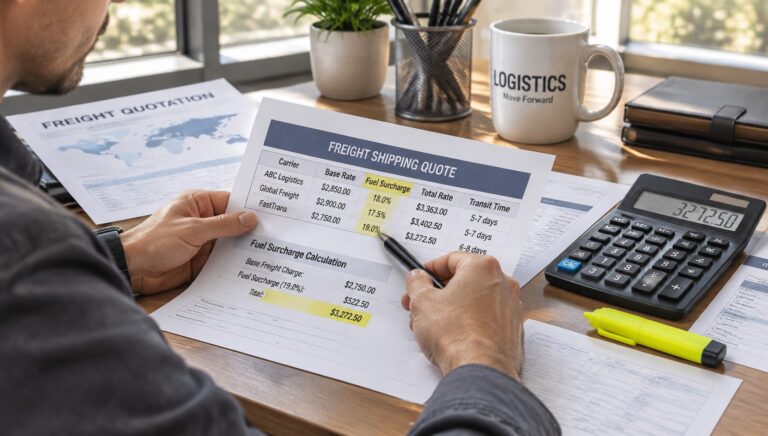

Start With the Shipment, Not the Premium
A cargo insurance quote is useful only when it reflects the shipment you are actually moving. The cargo insurance cost usually comes from the insured value multiplied by a rate that the insurer assigns to the cargo, route, mode, and policy terms, plus any minimum premium or policy fee. Two offers rarely compare cleanly at first glance. One may insure invoice value from the supplier’s dock to your warehouse, while the other starts at the port, leaves the deductible blank, or excludes the losses most likely on this move. Before you approve either one, confirm the cargo description, insured value, packing method, pickup point, delivery point, and coverage period. This page shows how the premium is calculated, which factors move the rate, and which questions to settle with the forwarder or insurer before you accept a quote.
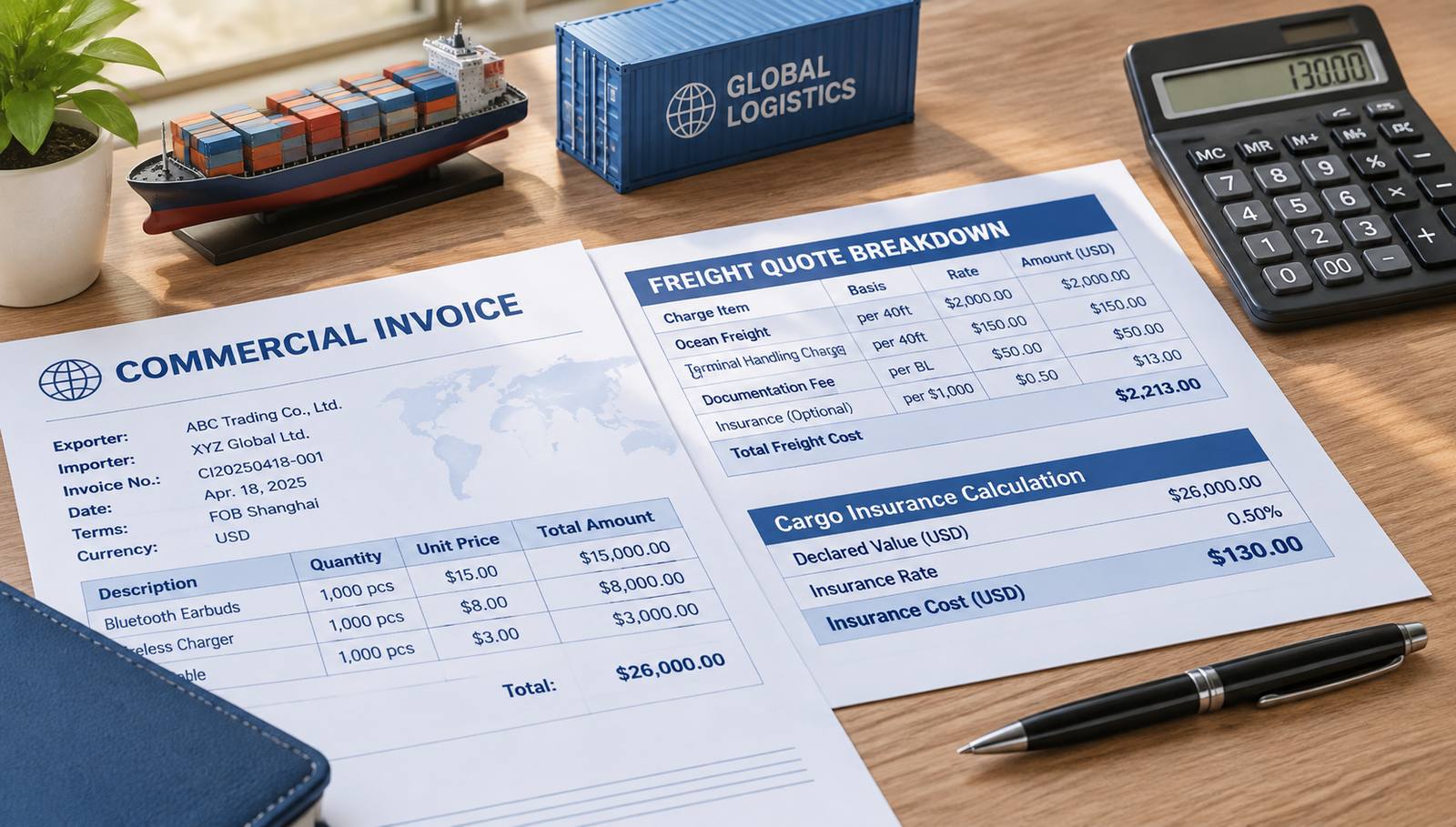
Align the Scope Before You Compare Insurance Quotes
A forwarding desk reads an insurance request in the same order it reads a booking: when the cargo is ready, where it is collected, how it travels, and where it is handed over. Insurance adds the value being insured, the points where cover starts and stops, and the share of each loss the buyer absorbs. Use this table as the baseline for every quote you collect.
| Field | What to state | Who confirms |
|---|---|---|
| Cargo-ready date | Date goods are packed and available | Shipper or supplier |
| Pickup and origin handling | Pickup address, loading method, origin warehouse stop | Shipper and forwarder |
| Route and service level | Origin, destination, mode, direct or transshipment | Forwarder |
| Cargo and packing | Description, packaging, quantity, weight, fragility | Shipper |
| Insured value basis | Invoice value, freight, or agreed uplift | Buyer and insurer |
| Coverage period | Where cover starts and where it ends | Insurer |
| Deductible and exclusions | Retained amount, excluded losses, claim steps | Insurer or broker |
Two offers become comparable only when every row matches. If one quote leaves the insured value basis blank, its premium tells you little, because the insurer may have priced a different sum. Quote validity works the same way: an offer issued before the cargo-ready date can lapse or be repriced if that date moves. Ask each provider to name the shipment details its quote relies on and the changes that would trigger a revision.
How Insured Value, Policy Limits, and Deductibles Affect Cost
A USD 1 million limit is the maximum available for covered losses under the policy terms. It is not the premium. If you insure a single shipment worth $1 million, the base premium comes from applying the quoted rate to that value. Under an annual open policy, the same limit may apply per shipment, per conveyance, per location, or in the aggregate, depending on the wording. Ask the insurer which structure applies and how it calculates the premium before you compare that quote with another offer.
When you weigh premium against deductible and coverage, treat them as three linked choices:
Premium: the price of the cover. A lower premium is not a better quote if the other two choices shift risk back to you.
Deductible: the part of each loss you absorb before the insurer pays. A higher deductible can reduce the premium, but your company carries more of every small claim.
Coverage: the losses the policy pays. Institute Cargo Clauses (A), commonly called all-risks cover, are broader than Clauses (B) and (C), which list specified perils, and Clause (C) is the narrowest. Even Clauses (A) carry exclusions and conditions.
A lower premium may therefore reflect a narrower coverage form rather than a better price for the same protection. Confirm the clause, the excluded losses, any endorsements, and how the policy treats inadequate packing and delay. Then decide how large a loss your operation can absorb, and ask each provider to price the same clause at the same deductible.
Which Party Arranges Cover Under CIF and CIP Sale Terms
The agreed sale terms can decide who must buy insurance and how much cover is required. Under the 2020 ICC trade rules, CIF generally requires the seller to obtain cover meeting at least Institute Cargo Clauses (C), while CIP generally requires cover meeting Clauses (A). Both rules generally call for cover of at least 110% of the contract price, unless the parties agree otherwise.
A seller’s policy can still fall short of what the buyer needs. Ask for the insurance certificate, then check the named destination, the policy period, the exclusions, and the claim contact. Under other sale terms, do not assume the seller has insured the cargo just because the seller pays for transport. Confirm which party carries the risk at each stage and who must obtain the policy under the sales contract.
What the Quote Includes and Who Acts
An insurance line on a freight quote is only as useful as the handoffs it spans. Map each line to a point in the movement, then name who can verify it. Anything the wording does not state, such as where cover starts, where it ends, the deductible, and the claim contact, stays a question for the provider until it appears in writing.
The origin handoff deserves the first question. If a truck collects the cargo from the supplier, ask whether cover attaches at that pickup or only at the port. A trucking freight pickup adds loading, road transit, and a terminal drop, and each of those can sit inside or outside the policy period. Rail movements add terminal transfers of their own, so a quote for rail freight should name rail as a covered mode rather than rely on a general route description.
A door-to-door service joins origin pickup and destination delivery into one scope, which makes it easier to request one continuous coverage period. Still, ask the forwarder to confirm in writing that the policy period matches the service scope and does not stop at the destination port.
Clearance raises a different question. A broker handling customs brokerage files the entry and coordinates release, but the broker does not act as the insurer. Ask the buyer or insurer whether duties and taxes sit inside the insured value, because that choice changes both the premium and the amount a claim can recover.
Note: A freight quote is tied to the cargo, handoffs, route, service level, timing, and destination work stated in it. Carrier and handling conditions can change. Align the scope first, then request confirmation for the specific shipment.
Cover Options That Fit the Shipment
Three insurance arrangements differ in who holds the policy, how much control you keep, and what the quote can show. Compare them under the same scope rather than by price alone.
Forwarder-arranged single-shipment cover: This fits occasional shippers who want cover tied to one booking, and forwarder-arranged cargo insurance keeps the insurance request next to the transport booking. It fits poorly when shipments are frequent, because each certificate is priced on its own. Ask which loss events the certificate covers and who handles the claim.
Annual open policy: This suits importers with regular shipments who want standing terms. It is a weak fit for a single one-off move. Ask about the per-shipment limit and how each shipment is declared.
Buyer-arranged policy: This suits buyers with an existing insurer relationship. It fits poorly when the buyer cannot show the forwarder the policy period or the claim contact. Ask who notifies the insurer after a loss, and confirm that the policy names the route and mode.
Carrier liability belongs in a separate decision. It describes what the carrier owes for loss or damage under the transport contract and applicable law, usually with limits, conditions, and exceptions. Parcel shippers often meet it through an express service, where the courier’s terms or a declared-value option may change the compensation available. Neither amounts to an independent cargo policy. Ask for the compensation limit, the excluded events, and the claim requirements, and arrange separate cover when the goods are worth more than the limit.
Common Cargo Insurance Quote Problems and How to Avoid Them
Most revisions start with a fact that changed after the quote was issued. A cargo-ready date that slips, a pickup address that gets corrected, or a supplier who ships in different packing can force the insurer to reprice or decline. Ask the forwarder which changes require a new quote and who approves the revision.
Declared value is the second common gap. If the insured value falls below the value the policy requires, the shipment may be underinsured. Some policies contain an average clause that reduces claim payments in proportion to the shortfall, and the settlement depends on the wording and the valuation basis. Ask the insurer whether an average clause applies and how it would affect a partial or total loss. Packing is the third gap, because insurers can exclude loss caused by inadequate packing.
Cargo that does not fit a standard container needs a closer look. Heavy, oversized, or loose break bulk cargo may need a survey or specific stowage terms before an insurer will quote. Final-mile deliveries add another handoff. For Amazon FBA deliveries, ask whether cover ends at the warehouse gate or after the receiving appointment, and whether a missed appointment, storage, or rebooking extends the policy period.
Common mistake: choosing the lowest premium without checking that the coverage period includes the inland pickup and the final delivery. A short policy period can leave the riskiest handoffs outside cover.
Risk: if the packing method or the declared value changes after the quote is issued, the insurer may revise the terms or decline a later claim. Request written confirmation of any change before the cargo is loaded.
Quote-Request Handoff: Documents to Send and Who Confirms
A complete request lets the provider assess the cargo, value, routing, and required cover without a second round of questions. Prepare these items before you ask for a quotation:
Commercial invoice: confirms the goods description, quantity, and declared value. The shipper or supplier supplies it.
Packing list: gives package dimensions, weights, and packing details, which the desk can check against the invoice.
Cargo photos or packing specifications: show how the goods are protected, which helps the insurer judge the rate and any packing exclusion.
Shipping instructions: state origin, destination, mode, cargo-ready date, and any transshipment. The forwarder confirms the routing the insurer will rely on.
Delivery instructions: identify the final delivery point, access limits, and any receiving appointment, which decide where cover should end.
Insurance requirements: state the insured value basis, the coverage form, the deductible, and any extra risks to cover. The buyer and seller settle these under the sales contract.
Importers who manage the whole inbound movement can tie these inputs to an import service scope, so the insurance request and the transport booking use the same cargo facts. When the documents are ready, send an inquiry, ask the insurer to flag any missing information, and request the policy period, exclusions, deductible, and premium calculation in writing.
Which Cargo Insurance Quote to Request First
Request a quote built on the full scope first: invoice value, pickup to final delivery, a named coverage form, and a stated deductible. That quote gives you a baseline, and every other offer can be measured against it. For an occasional shipment, a single-shipment certificate from the forwarder is the practical default. For regular shipments, ask for open-policy terms alongside it and compare how each handles the per-shipment limit.

The nature of the cargo is the factor most likely to change this recommendation. Fragile, high-value, restricted, or unusually packed goods need the insurer’s review before you pick a deductible, because exclusions may matter more than the rate. Settle that review first, then choose the deductible you can absorb.
Illustrative example (not a customer case): A buyer receives two insurance offers for the same boxed pallets. The first states cover from the supplier’s loading dock to the buyer’s warehouse door, names the insured value basis, and lists the deductible. The second starts at the origin port and leaves the deductible blank. The buyer asks the forwarder to rebuild the second offer on the first one’s scope before comparing the two.
Key Takeaways
Scope first: compare insurance offers only after the cargo, route, insured value, and coverage period match.
Charge basis: the base premium comes from the insured value and the quoted rate, so ask for each as a separate line along with any minimum premium or fee.
Limit versus price: a policy limit describes maximum payout, not what the shipment costs to insure.
Coverage form: check the Institute Cargo Clause and the exclusions, because a lower premium may reflect narrower cover.
Responsibility: confirm who must arrange cover under the sale terms, and do not treat carrier liability as a policy.
Changes: a new cargo-ready date, packing method, or declared value can require a revised quote.
FAQ
What determines cargo insurance cost for a shipment?
The insurer assigns a rate based on the cargo, packing, route, mode, and coverage terms, then applies it to the insured value. A deductible, minimum premium, or policy fee can change the final amount. Ask each provider to list these components separately so you can see why two quotes differ.
Is a $1 million limit the same as the premium?
No. A limit is the most the insurer will pay for covered losses, while the premium is what you pay for the cover. A single shipment worth $1 million is priced on that value. A limit under an annual policy may apply per shipment or in aggregate, so ask which structure the quote describes.
Does a higher deductible lower the premium?
It can, because the insurer pays less on each small loss. The trade-off is that your company absorbs more of every claim before payment starts. Decide what loss you can carry without disrupting operations, then ask each provider to price the same coverage form at that deductible.
Is freight insurance the same as cargo insurance?
The terms are sometimes used interchangeably, but the actual cover depends on the policy wording. Cargo insurance generally protects the goods in transit, while a freight-related arrangement may protect a different interest, such as the freight charges. Ask the provider to confirm whether the insured property is the goods, the freight, or both.
Does the carrier’s liability replace cargo insurance?
Usually not. Carrier liability is limited by the transport contract or applicable rules, and it may not reflect the value of your goods. Insurance is a separate contract that protects the buyer. Ask the carrier or forwarder to state the liability limit, the excluded events, and the claim steps, then compare them with the insured value.
Does an all-risks label mean every loss is paid?
No. Broad cover under Institute Cargo Clauses (A) still carries exclusions and conditions, and some losses, such as those tied to inadequate packing or delay, may fall outside it. Read the actual wording, confirm the clause the quote uses, and ask the provider to list the exclusions that matter for your cargo.
Who should buy the insurance, the shipper or the buyer?
The answer depends on the sale terms and on which party bears risk at each stage of the movement. The buyer and seller should confirm that allocation in the contract before booking. Then the party who holds the risk can request a quote that matches the stages it controls.
What information does a provider need to issue a quote?
Expect to supply the cargo description, invoice value, packing method, cargo-ready date, pickup point, route, mode, and delivery point. Special handling needs, such as temperature control or restricted goods, should also be disclosed. Complete facts reduce revisions and help the insurer match the cover to the shipment.
Disclaimer: This page is general quote-planning guidance, not a binding quotation or delivery commitment. Actual charges and handoffs depend on the cargo, route, timing, provider confirmation, and destination conditions. Where duties, customs, tax, insurance, or contract questions apply, confirm them with the relevant party before booking.