

Which Pallet Format Fits Your Shipment
Choose the pallet format according to the facility that will unload, store, and re-ship the cargo, not according to the pallet that is easiest to source at origin. Shippers whose cargo stays inside European networks, or whose consignee already stores euro pallets, should keep that format. Shippers delivering to a US warehouse, cross-dock, or fulfillment site should lean toward the standard US pallet unless the consignee confirms that its racking, handling equipment, and receiving rules accept euro pallets. The main trade-off is container fit against receiving-site fit, because a pallet that loads well can still be refused, re-palletized, or stored badly at the destination. The fact most likely to change the answer is the consignee’s receiving specification. Euro pallet dimensions also change how cargo sits on a container or trailer floor, so ask the forwarder for a load plan in each format before the supplier builds pallets.
Set a Fair Basis for Comparison
A fair comparison starts with identical shipment facts. When one option is quoted for a different delivery point, packing scope, or service level, the gap in price and timing reflects the quotes rather than the pallets. Align the conditions below first.
| Condition | What to Align | Why It Matters |
|---|---|---|
| Cargo | Carton size, weight per pallet, stackability | Footprint drives carton pattern and layer stability |
| Pallet type | EPAL or EUR marking, condition, repair history | A market name does not guarantee the specification |
| Route and equipment | Container or trailer type, planned orientation | Floor-space use changes with footprint and orientation |
| Delivery point | Warehouse, cross-dock, or fulfillment site | Each site sets its own pallet and storage rules |
| Service scope | Port-to-port, or door-to-door with unloading | Scope decides who handles pallet changes on arrival |
| Quote inclusion | Pallet supply, wrapping, palletizing, re-palletizing | Omitted lines hide the true cost of a format |
| Customs role | Wood packaging mark, entry filing | Documentation gaps can delay release at entry |
Confirm each row in writing. If a row stays unknown, keep the comparison conditional and name the missing input in the quote request.
Euro Pallet Size Versus US Pallet Size
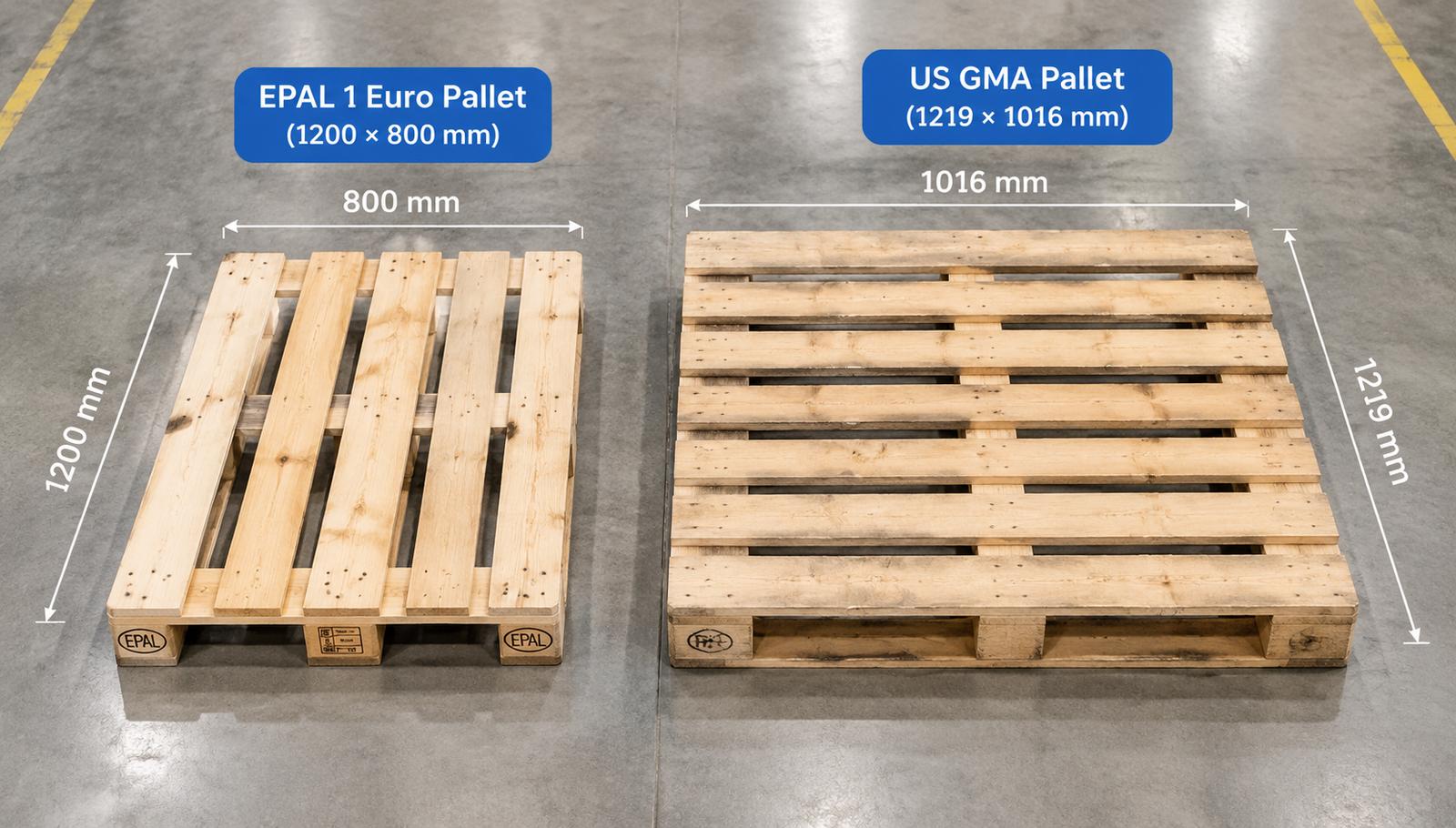
Euro pallet is a market name for the standardized EUR/EPAL pallet, and the type most shippers mean is EPAL 1. Its usual US counterpart is the GMA-style pallet, the most widely used US format. US pallets still vary in size and construction, so treat that format as the common reference rather than the only one. The table puts both references side by side.
| Specification | EPAL 1 Euro Pallet | Common US GMA Pallet |
|---|---|---|
| Footprint (mm) | 1200 × 800 | 1219 × 1016 |
| Footprint (inches) | 47.2 × 31.5 | 48 × 40 |
| Pallet height | 144 mm (5.7 in) | Varies by construction |
| Floor area | About 0.96 m² | About 1.24 m² |
| Empty weight | About 25 kg | Varies by construction |
| Safe working load | 1,500 kg under the EPAL specification | Varies by pallet and manufacturer |
The euro values follow the EPAL 1 specification and carry manufacturing tolerances. US values depend on the manufacturer, so confirm the exact pallet with the supplier. The US pallet is larger on both sides, with the bigger gap on the short side, and that gap changes carton patterns, floor layouts, and rack fit. Pallet height also counts toward total loaded height, so add it to the cargo height before checking container, trailer, rack, or aircraft limits.
Confirm the pallet type
A pallet sold as a euro pallet does not automatically meet the EPAL 1 specification. EPAL licenses production and repair, and its markings and repair stamps show which pallets went through that system. Ask the supplier to confirm the pallet type, markings, and repair history in writing, and inspect a sample before loading.
Pallet weight and load capacity
Empty pallet weight adds to the shipment’s gross weight, and the table shows a nominal reference only. The load rating belongs to the pallet type and construction, not to the footprint, so a pallet with the right footprint can still be unsuitable for a heavy or stacked load. For US-format pallets, request the manufacturer’s rating for the specific pallet, and check whether the load will be racked, stacked, or moved by hand jack.
Euro pallet through to destination
This format suits cargo that moves through European networks, or that ends at a site whose racking and handling equipment were built around the euro footprint. The supplier palletizes once, and the consignee receives the same pallets without rework. It fits poorly at a site that stores US pallets, where a different footprint can disrupt rack placement, conveyor flow, and pallet-jack handling. Choose it only after the consignee approves the format for its own equipment.
US standard pallet from origin
Buyers delivering to US warehouses, fulfillment sites, and retail distribution centers usually find this format easier to receive, because the site’s equipment already expects the footprint. The supplier or forwarder palletizes to the US size before loading. The format fits poorly when a European supplier builds only on euro pallets, or when container floor space matters more than receiving ease. Select it when the destination specification names the US pallet or the receiving rules are unknown.
Euro pallet in transit, re-palletized at destination
This hybrid works when the supplier can build only euro pallets but the final site needs a different format. The cargo travels on euro pallets, and a destination crew or third-party handler moves it onto US pallets before delivery. The extra step adds labor and a damage-exposure point, so the hybrid fits poorly with fragile cartons or a delivery appointment that leaves no room for rework. Use it only when the quote names who performs and prices the transfer.
How Pallet Size Affects Container Loading
The footprint difference first shows up on the container floor. The two formats create different floor layouts even when they carry identical cartons, and a smaller footprint does not guarantee a better result. Stability, carton overhang, and stacking limits decide the usable load, so no fixed pallet count applies without a verified plan. Check these factors before you select a format.

Container dimensions: Use the actual internal length and width of the selected container, not its nominal size.
Pallet orientation: Test whether pallets can rotate or mix directions without leaving unsafe gaps.
Carton pattern: Confirm that cartons stay inside the pallet footprint and that layers remain stable.
Height and stacking: Add pallet height to cargo height, and check whether loaded pallets may be stacked.
Weight distribution: Confirm that cargo weight spreads safely across the container floor.
Ask the provider handling your sea freight for two load plans built on the same container type, carton dimensions, cargo weight, and stacking limits. Each plan should show the pallet count, total cargo quantity, unused floor space, loaded height, and handling limits, so the comparison rests on actual shipment capacity.
Air cargo works differently. It is normally built onto airline unit load devices, so confirm with your air freight provider whether the shipper’s pallet stays in the build and which height limit applies to the loaded pallet.
Core Decision Matrix
The matrix compares the three pallet approaches under the same shipment conditions. Every cell stays qualitative, because the numbers that settle the choice come from the quote and the load plan.
| Option | Strong Fit | Weak Fit | Main Trade-Off | What to Verify |
|---|---|---|---|---|
| Euro pallet through to destination | Consignee stores euro pallets; cargo continues in European networks | US site with racking built for US pallets | Smooth European handling versus receiving friction in the US | Written consignee approval of the format |
| US standard pallet from origin | US warehouse or fulfillment destination; receiving rules unknown | Supplier that builds only euro pallets | Easier receiving versus possible loss of container floor space | Load plan for the planned container type |
| Euro pallet, re-palletized at destination | Euro-only supplier with a US final site | Fragile cartons; tight receiving appointment | Compliant receiving format versus an added handling step | Who performs and prices the transfer |
Start with the destination receiving specification, because the receiving site accepts or rejects a pallet no matter how well it loaded. If the consignee names the US format, build it at origin or price a destination transfer as a separate line. If the consignee confirms the euro format and the load plan supports it, keeping that format avoids re-handling. When the consignee stays silent, default to the standard US pallet for a US warehouse.
Field note: A verbal assurance that euro pallets are acceptable may not cover rack beam support, conveyor width, or automated handling limits. Ask the consignee for the racking or equipment specification, and keep the reply in the booking file.
Cost and Quote-Scope Trade-Offs
Pallet format affects the total shipment charge through several separate lines, and a headline freight charge shows only one of them. The pallet carries a supply charge or an exchange obligation, depending on whether it is bought, hired, or returned. Palletizing and wrapping labor depends on who builds the load and how well the carton pattern fits the footprint. Container or trailer space use depends on how the footprint sits on the floor, which is why the load plan matters more than the pallet’s purchase price.
Destination handling forms the other half of the picture. A euro pallet delivered to a US site can trigger re-palletizing labor, receiving fees, or rework charges if the consignee rejects the format. A US pallet built at origin can remove those lines but may use floor space less efficiently. Neither outcome is fixed; the quote inputs settle it.
Buyers often ask for a breakeven point where one format becomes cheaper. No reliable breakeven exists without the carton dimensions, pallet count, container or trailer type, supplier labor terms, and destination handling terms. Ask the forwarder to price both formats against the same load plan, with each line shown separately: pallet supply, palletizing, loading, freight, destination handling, and re-palletizing. A lower headline often reflects a quote that leaves out one of those lines, so hold scope constant before you rank quotes.
Note: Freight rates and total shipment charges change with cargo details, route, service scope, carrier conditions, timing, destination handling, and applicable responsibilities. Compare current quotes only after their scope has been aligned.
Time, Handoffs, and Delivery Cycle
This page gives no transit figures, because the route, mode, and service scope are not fixed. The pallet format changes the number of handoffs in the delivery cycle, so confirm the timing of each handoff below. Keep main transport time separate from the total delivery cycle, which also includes preparation, loading, customs, transfers, and receiving.
Booking and palletizing
The supplier builds pallets to the agreed format. Confirm the format before packing starts, since a change after palletizing means rebuilding loads.
Loading and consolidation
The forwarder loads pallets according to the load plan. Shared containers add a consolidation cutoff, while full containers depend on the planned orientation.
Main transport
The carrier’s schedule governs this leg. Pallet format does not change that schedule, but it can change how many units each container or trailer carries.
Customs and inspection
The customs broker handles entry filing. Confirm that wood packaging marks are visible on the pallets, because a documentation gap can delay release.
Destination transfer
At the destination terminal, the load is unstacked and, where the plan requires, moved to a different pallet format. Ask whether this step has its own appointment or queue.
Final delivery and receiving
The delivery carrier brings the pallets to the warehouse appointment. The consignee’s receiving rules decide whether the pallets are accepted, re-handled, or rejected.
Before booking the inland leg, confirm that the selected trucking freight service can accommodate the loaded pallet dimensions, trailer configuration, and unloading method at the destination.
A door-to-door service places these handoffs under one scope, so confirm what that scope includes: unloading, re-palletizing, pallet disposal or return, and the delivery appointment. Where the scope ends at the destination terminal, the consignee owns the remaining steps.
Responsibility and Service Boundaries
Pallet format is a loading decision. It does not change the transport mode, the service scope, or who owns duties and taxes, so the quote should keep each of those items separate. The agreed trade term assigns responsibility for the origin and destination legs; read it alongside the pallet instruction so palletizing and any re-palletizing have a named owner.
Wood pallets count as wood packaging material, and plant-health rules govern them separately from the freight quote. For US-bound cargo, USDA APHIS places the responsibility on the importer to ensure that wood packaging is treated and carries the ISPM 15 mark. The mark sits on the wood itself, so inspect the pallets rather than relying on paperwork alone, and remember that exemptions and special cases can apply. Ask your customs brokerage provider to confirm the current requirement before pallets are built.
The importer role stays with the party named on the entry, whichever pallet format is used. If the buyer needs help defining who acts as importer and who arranges delivery, review the import service scope before the booking is confirmed.
Destination receiving rules sit outside the freight quote but still decide the outcome. Fulfillment sites publish their own inbound pallet and labeling requirements, and these can override a consignee’s usual practice. For Amazon FBA shipments, collect the current inbound rules before palletizing starts, because a wrong format typically means rework at the destination.
Pallet ownership and return terms also need an explicit answer. Decide whether pallets are one-way, exchanged, or returned, since exchange practices that work in European networks may not apply at a US receiving site.
Selection Rules and Quote Preparation
Collect the shipment inputs first, then apply the rules. The forwarder needs the carton dimensions and weight, the planned cartons per pallet, stackability limits, the pallet format and type the supplier can build, the container or trailer type, the destination’s written receiving specification, the wood packaging requirement, and the delivery scope. Without these inputs, any comparison remains conditional.
Default rule: Use the standard US pallet for a US warehouse destination unless the consignee approves euro pallets in writing.
Euro format rule: Keep euro pallets when the consignee’s racking and equipment already handle them, or when the cargo continues into a European network.
Weak-fit rule: Drop a format if the load plan shows overhang, crushed edges, or unstable layers, and accept a destination transfer only when the supplier cannot build the required format and the quote names who performs it.
Changing-fact rule: Rerun the comparison when the container type, delivery point, or carton configuration changes, because each one alters the load plan.
Illustrative example (not a customer case): A shipper plans to move cartons from a supplier that builds only on euro pallets to a US distribution warehouse. The consignee has not stated its receiving format. The load plan shows that euro pallets fit the container floor well, but the warehouse racking specification does not clearly support the narrower footprint. The shipper asks for both options to be priced on the same scope, including a destination transfer line. The decision then rests on rack support and handling risk rather than container fit alone, and the shipper waits for the consignee’s reply before releasing production packing.
Common Mistakes and Controls
Most avoidable cost traces back to three failures. Quote scope differs between providers, so a cheaper headline hides pallet supply or a destination transfer. Buyers also treat the pallet choice as a mode or service-scope decision, which blurs who owns each handoff. Finally, cargo or destination facts go missing, and the forwarder plans on assumptions.
Common mistake: Ordering pallets by market name alone. A pallet sold as a euro pallet may lack the EPAL markings, the expected condition, or a verifiable repair history, and the problem surfaces at loading or at the receiving dock.
Risk alert: Do not load wood pallets for US-bound cargo until the ISPM 15 mark is visible on the pallets themselves and the broker has confirmed the current requirement. A pallet without the mark can hold up the whole shipment.
Disclosure: This page provides general freight comparison guidance and may mention freight services available through this website. Actual cost, timing, service scope, customs requirements, carrier conditions, and destination handling depend on the shipment and can change. Confirm the current shipment plan before booking.
Key Takeaways
Choose the pallet format from the receiving site’s requirements first and from container fit second.
Confirm the pallet type, not just the market name, and compare both formats on the same carton pattern and load plan.
Compare quotes only after pallet supply, palletizing, loading, freight, destination handling, and any re-palletizing share one scope.
Verify the wood packaging mark and the receiving specification before palletizing, because both are costly to fix after loading.
FAQ
What are standard euro pallet dimensions in inches?
The specification table above lists the euro pallet footprint and height in both millimeters and inches, next to the common US pallet. Those values describe the EPAL 1 type, so confirm the pallet type before you order or plan a load.
Are all pallets sold as euro pallets the same?
No. Euro pallet is a market name, and only pallets built or repaired within the EPAL system carry its markings. Check the markings, condition, and repair history, and ask the supplier to confirm the pallet type in writing.
How much bigger is a US pallet than a euro pallet?
The common US pallet is larger on both sides, with the bigger difference on the short side, so it covers a noticeably larger floor area. The effect on loading depends on carton size, orientation, and container type, so compare both formats on the same load plan.
Does the pallet height limit how much I can load?
Pallet height counts toward total loaded height, so add it to the cargo height before checking container, trailer, rack, or aircraft limits. The loaded height, not the pallet alone, decides whether the unit fits.
How many euro pallets fit in a shipping container?
The count depends on the container type, its internal dimensions, pallet orientation, carton pattern, and stacking limits. A floor-area estimate alone does not give a safe plan, so ask the forwarder to verify the layout against the actual cargo.
Can a US warehouse accept euro pallets?
Some can, but acceptance depends on racking, conveyors, handling equipment, and the site’s receiving rules. Get the consignee’s confirmation on each of these items before palletizing.
Do wood pallets need an ISPM 15 mark for US-bound cargo?
Wood pallets fall under wood packaging rules for international movement, and the mark is a physical stamp on the wood. Inspect the pallets for it, and ask the customs broker to confirm the current requirement before loading.
What does my forwarder need to compare the two formats?
Provide the carton dimensions and weight, the pallet formats and types the supplier can build, the container or trailer type, the consignee’s receiving specification, the wood packaging requirement, and the delivery scope. With these inputs, the forwarder can quote both formats on the same scope.
Disclaimer: Freight comparison information on this page is general planning guidance, not a binding quotation, carrier commitment, customs ruling, legal opinion, or delivery guarantee. Suitability depends on cargo, route, scope, timing, provider terms, and destination conditions. Confirm current shipment requirements before booking.