

Reviewed by TJ Logistics Team — October 2026. TJ Logistics Team reviewed the route content, current planning references, and Angola destination-preparation points for October 2026. The formal quotation and booking are prepared against the defined shipment.
Shipping from China to Angola: Route Overview
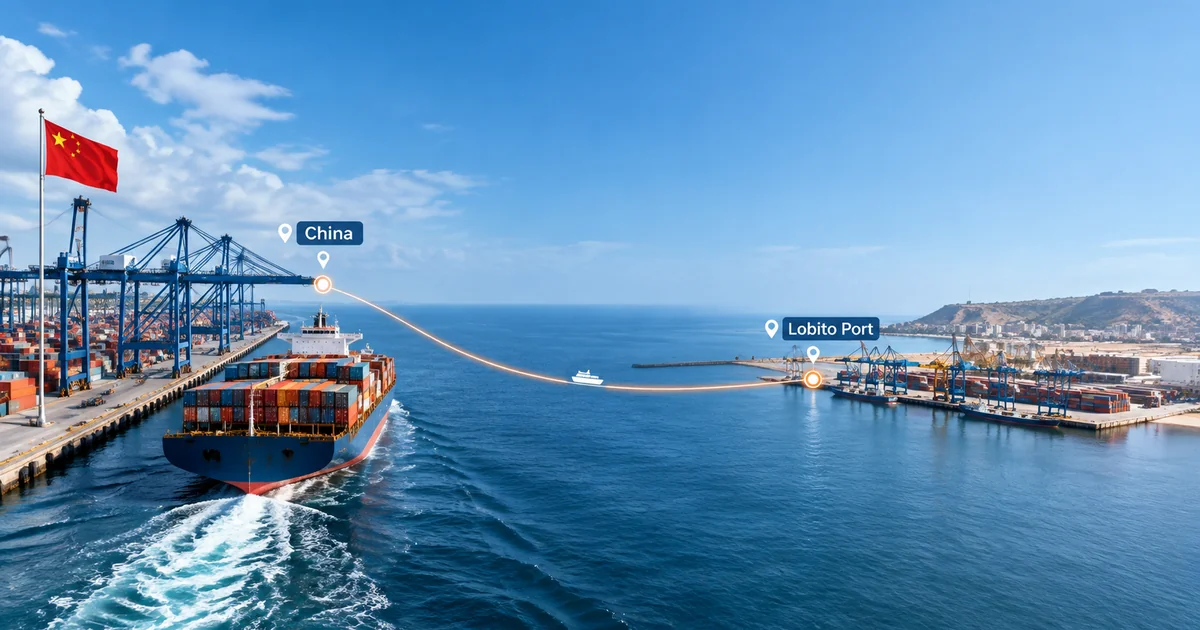
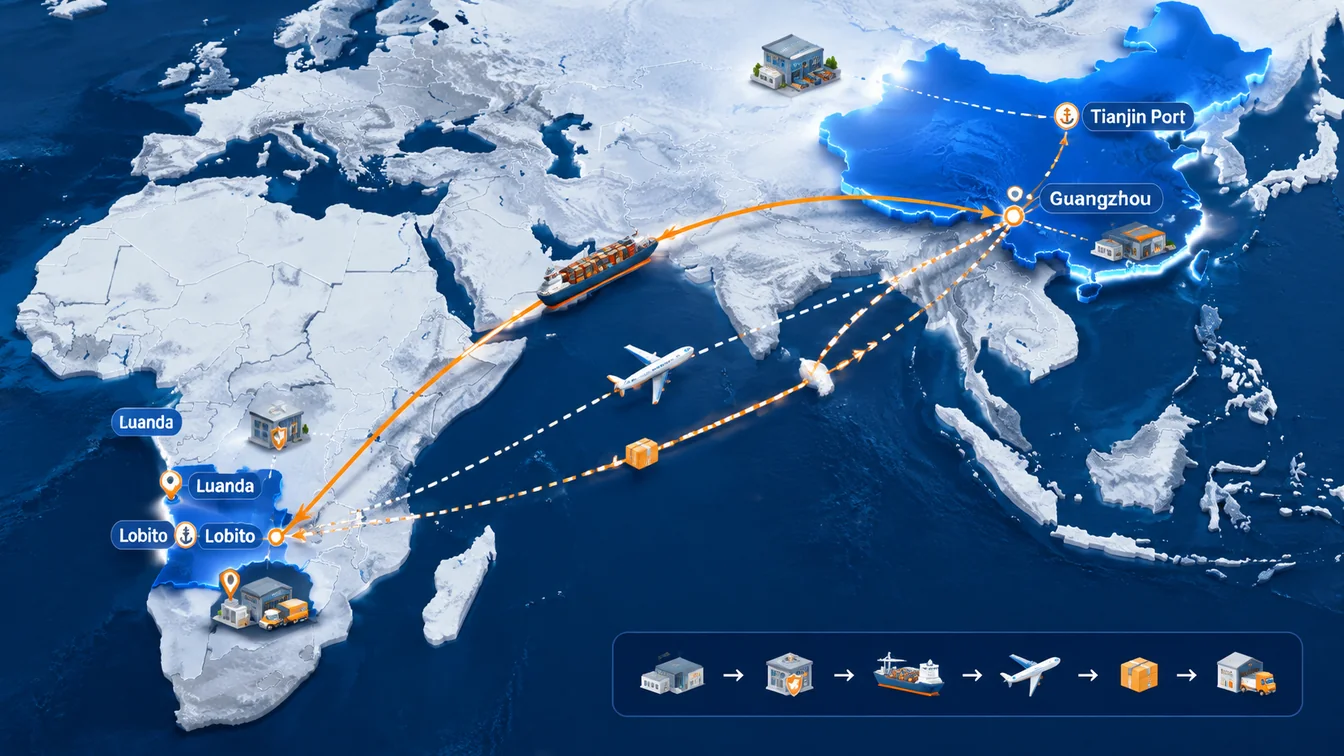
For FCL 20GP from Tianjin Port, China to Lobito Port, Angola, the TJ Logistics Team indicative client rate reference is $1,773–$1,827 per container, with a 44-day planning-transit reference for October 2026. This named ocean route is a starting point for container-ready cargo, while the Guangzhou-to-Luanda air freight and express references serve different urgency and handling requirements.
A practical China-to-Angola route connects supplier readiness with a suitable China export gateway, the selected international transport path, entry and customs handling in Angola, and delivery to the consignee’s actual address. The gateway decision should reflect both the supplier’s location and whether the final destination is better served through Luanda or Lobito.
China to Angola Shipping Cost and Transit Time
Current TJ Logistics Team planning references provide route-specific China-to-Angola prices and transit times for October 2026. Each reference applies to its named route, method, equipment or unit.
| Shipping route | Shipping method | Price | Transit time |
|---|---|---|---|
| Tianjin Port, China → Lobito Port, Angola | FCL 20GP | $1,773–$1,827 per container | 44 days |
| Tianjin Port, China → Lobito Port, Angola | FCL 40GP | $2,835–$2,925 per container | 44 days |
| Tianjin Port, China → Lobito Port, Angola | FCL 40HQ | $2,835–$2,925 per container | 44 days |
| Guangzhou Baiyun (CAN), China → Luanda (LAD), Angola | Air freight | $4.95–$6.30/kg | 5–9 days |
| Guangzhou, China → Luanda, Angola | Express | $8.10–$9.90/kg | 3–5 days |
Rate scope: These TJ Logistics Team planning references apply to the shipping route, method, equipment or unit shown. They are not market averages or binding quotations. The formal quotation confirms the agreed collection, delivery, customs, and charge scope for the shipment.
How to Choose a Shipping Method from China to Angola
Shipment form and delivery urgency provide the clearest starting point for choosing among the China-to-Angola methods:

- Choose FCL when the cargo needs a dedicated container and can be loaded safely, because a full-container movement gives the shipment its own container equipment; the destination’s ability to receive and unload it also matters.
- Choose LCL when the cargo suits shared container space rather than a dedicated unit, because consolidation can accommodate smaller consignments; the Shenzhen-to-Luanda route via Durban must have a suitable consolidation and transfer plan for the required delivery date.
- Choose air freight when the required arrival timing justifies air-cargo handling, because a named Guangzhou Baiyun-to-Luanda airport reference is available; actual and chargeable weight, dimensions, and cargo acceptance affect suitability.
- Choose express when a time-critical parcel fits courier acceptance rules and the destination address is serviceable, because the express service combines network handling with parcel delivery; shipment contents and local delivery coverage can change the choice.
- FCL ocean freight
- Use when: A shipment requires a dedicated 20GP, 40GP or 40HQ container and the consignee can manage containerized cargo. Key route check: The sea freight service is the relevant service category, and the Tianjin-to-Lobito reference must fit the final delivery area.
- LCL ocean freight
- Use when: Shared container space is more appropriate than reserving a dedicated unit. Key route check: The Shenzhen-to-Luanda path via Durban needs a defined transit basis, consolidation arrangements and destination-handling scope before it can be compared reliably with another method.
- Air freight
- Use when: Delivery timing takes priority over the economics of an ocean movement and the cargo meets air acceptance requirements. Key route check: The air freight service reference names Guangzhou Baiyun (CAN) and Luanda (LAD), so the shipment’s actual airport handoffs and collection or delivery scope must match the plan.
- Express
- Use when: A time-sensitive parcel is suitable for courier handling and the receiving address falls within the selected service’s coverage. Key route check: The express service reference names Guangzhou and Luanda, rather than a specific airport pair, so courier eligibility and last-mile delivery conditions remain material.
Plan a China-to-Angola Shipment from Supplier to Final Delivery
The common shipment chain runs from supplier cargo readiness in China through the export handoff and selected international movement to Angola arrival, customs release, and delivery to the named consignee. The agreed transport method determines which handoffs need particular attention after that common chain is defined.
- FCL: Container loading and release
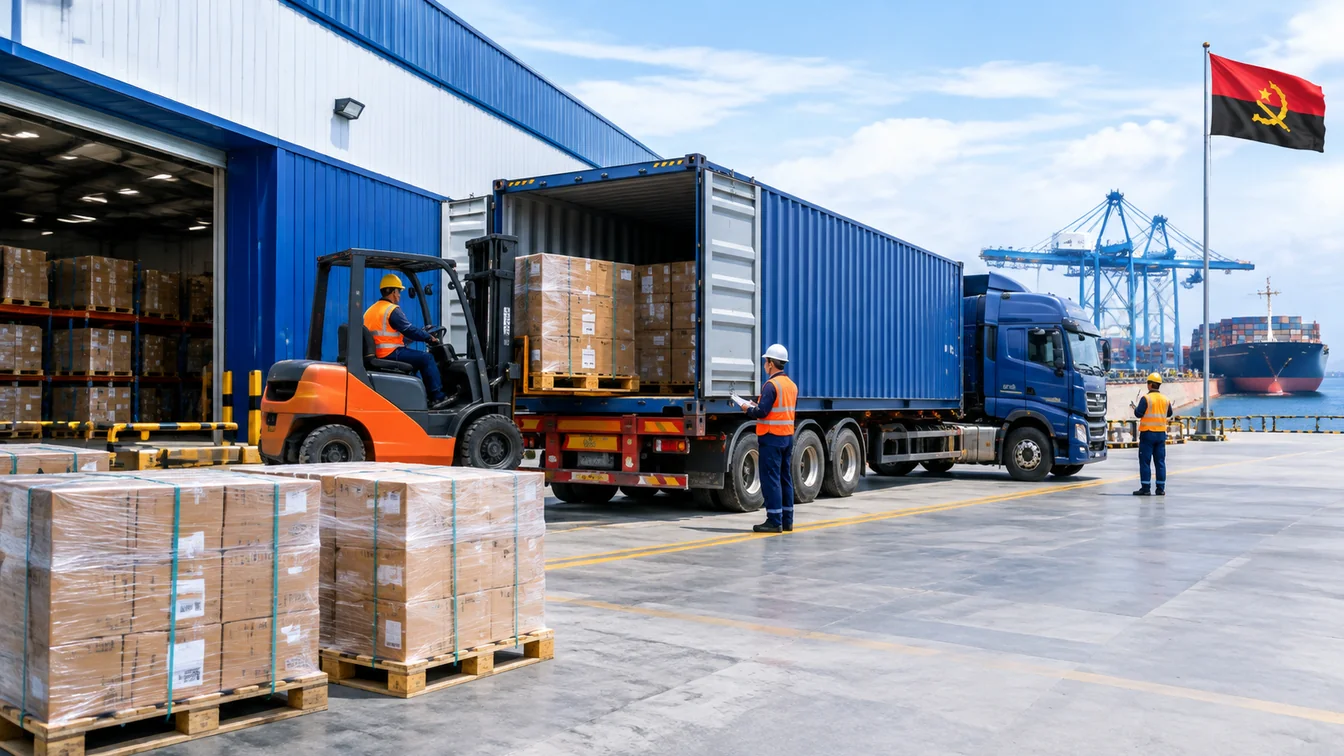
- The Tianjin Port-to-Lobito Port reference requires a clear allocation of container loading, sealing, export handoff and arrival-release responsibilities. The final road leg and any applicable empty-equipment return must be defined against the consignee’s receiving arrangements; the door-to-door service is relevant when the agreed scope extends beyond the international gateway to the final address.
- Air freight: Airport cargo handoffs
- The named Guangzhou Baiyun (CAN)-to-Luanda (LAD) reference makes airport cargo acceptance and arrival collection key handoffs. Cargo dimensions, actual and chargeable weight, acceptance conditions, customs release and responsibility for final delivery need to fit the selected service; no particular flight or transfer pattern is assumed.
- Express: Courier and last-mile handoffs
- The Guangzhou-to-Luanda express reference uses a city-pair description rather than a specific airport pair. The shipment plan should distinguish origin pickup, courier network acceptance, the import-clearance handoff and final delivery, subject to the selected service’s eligible contents and address coverage.
Execution Checks Before Booking
- For FCL, allocate container loading and sealing, arrival release, destination collection, and any required empty-equipment return.
- For air freight, establish cargo acceptance and arrival-collection responsibilities under the selected airport handling arrangement.
- For express, establish the courier handoff and ensure the consignee can receive the parcel at the stated address under the selected service conditions.
Choosing Angola Entry Gateways and Inland Delivery Routes
Angola’s final delivery area changes the gateway comparison: Luanda is the natural starting point for capital-region deliveries, while Lobito provides a different geographic reference for some central and eastern inland destinations. The final address and the availability of a suitable onward movement determine whether that geographic distinction changes the practical route.
| Final delivery area | Typical route pattern | Why the pattern fits | Details needed for the quote |
|---|---|---|---|
| Luanda and nearby north-western deliveries | For ocean cargo to the capital region, the Port of Luanda is the principal seaport gateway to compare; the named air-freight and express references also identify Luanda as the destination. | The port is located in Angola’s most populous and economically dynamic region, making it a relevant starting point for capital-region cargo. | The exact municipality, complete receiving address, local delivery access and need for inland trucking freight coordination can change the last-mile plan. |
| Benguela, Huambo, Kuito, Luena and Luau corridor | The Tianjin Port-to-Lobito Port FCL reference is the named ocean comparison. The Lobito Atlantic Railway describes a railway from Lobito through Benguela, Huambo, Kuito and Luena to Luau, but its existence does not establish inbound rail availability for every import shipment. | For inland addresses near this corridor, a rail-assisted movement may warrant comparison with road delivery when the specific import journey and cargo are eligible. | Specify the final town and receiving address, offloading conditions, and whether a rail operator can accept the intended inbound cargo and destination movement. |
Prepare a Comparable Freight Request
Provide: the China supplier or pickup point; cargo-ready timing and cargo profile (type, packages, dimensions, weight, and CBM); any loading or special-handling condition; the final municipality, district and full receiving address, including any postal code used by the consignee; and the requested delivery scope, timing priority, and relevant importer or broker arrangement.
The formal quotation should state: the pickup and final-delivery boundary; transport method, equipment or unit, and routing pattern; the customs, destination-handling, and inland-delivery handoffs; material included and excluded charges; rate validity; and the conditions that can change the amount or timing.
Prepare for Angola Customs Before Departure
Imports into Angola require preparation for local customs entry, including a supported product classification, declared customs value and the applicable import declaration. The official Angola General Tax Administration (AGT) portal provides the customs tariff schedule and import/export information; the precise treatment depends on the product and the rules applicable when the goods enter Angola.

Customs Readiness Checklist
Angola import preparation starts with a clear product classification, a capable importer and a documented route for completing the local customs declaration.
- Confirm that the Angolan importer is eligible to import the product category and has the registration or authorization required for any controlled goods.
- Determine the tariff classification from the product’s actual characteristics and review the applicable duties and import taxes against the current Angolan tariff schedule.
- Prepare consistent commercial descriptions and value information for the customs valuation process, including any declaration of customs value required for the shipment.
- Allocate responsibility for the Documento Único import declaration and appoint an appropriately authorized local customs broker when required under Angolan rules.
- For sea cargo, have the local broker verify whether a CNCA loading certificate, also described as a Certificado de Embarque or ARC, applies to the shipment. The Angola import-document guide lists this certificate among import documents; verify the current requirement and issuance arrangements before departure.
- Determine whether the commodity requires an import licence, product-specific permit, conformity document or laboratory testing before dispatch.
- Assign who supplies missing records, responds to customs queries, authorizes amendments and pays applicable duties, taxes and assessed charges.
Documents to Prepare
The usual starting document set for China-to-Angola cargo includes the following, subject to the selected transport method and the product’s import requirements:
- Commercial invoice with a clear goods description, quantities and declared transaction values.
- Packing list showing package counts and the shipment’s physical contents.
- Transport document appropriate to the method, such as a bill of lading for ocean cargo or an air waybill for air freight.
- Product classification and supporting customs valuation information for the applicable import declaration and customs value declaration.
- Any required import licence, product permit, certificate, testing record or other commodity-specific compliance documentation.
- For sea shipments, the applicable loading certificate and related shipment records when required under the rules in force for that cargo.
For importer-side coordination, the customs brokerage service and import service pages are relevant service references, but they do not establish Angola-specific broker authorization or replace the designated Angolan importer and customs authorities.
Angola’s import licensing, tariff classification and shipment-document requirements can change by product and regulatory treatment. An Angolan customs broker should verify the applicable rules and any required loading certificate before the supplier releases the cargo.
Choose the Right Delivery Scope for China-to-Angola Shipping
| Service scope | What the scope means | Key responsibility or condition |
|---|---|---|
| Port-to-port | A sea-freight movement between the named origin and destination ports. Supplier pickup, destination customs release and inland delivery are separate unless included in the agreed service. | The parties responsible for export handoff and import release must be defined. The agreed scope determines whether port-related handling beyond the named movement is included. |
| Airport-to-airport | An air-cargo movement between the named airports. Supplier collection, import clearance, airport collection and final-address delivery are not automatically included. | The importing party or its appointed agent normally coordinates the import-clearance and collection handoff unless the agreement assigns these tasks differently. |
| Door-to-door | A coordinated movement from the specified pickup address in China to the named consignee address in Angola. Customs handling and duties follow the agreed contract rather than being automatically bundled into the transport scope. | The import-compliance role and payment responsibility must be clearly allocated. Local access, receiving arrangements and destination handling can affect the final delivery leg. |
| DDP (Delivered Duty Paid) | A contractual delivery term under which the seller undertakes delivery with import clearance and applicable duties and taxes allocated to the seller under the agreed Incoterms arrangement. It does not automatically include every examination, storage, compliance or receiving charge. | Use DDP only where the importer arrangement is legally workable in Angola and the contract clearly identifies who performs import formalities. Any additional charges or obligations outside that agreement remain subject to their actual allocation. |
For delivery beyond the immediate port or airport area, the agreed scope should name the actual receiving address and distinguish the international movement from the inland leg. The door-to-door service is relevant when the required scope extends to a final address; cargo insurance is a separate coverage decision and should not be assumed to be included in a transport service.
Why Use a Freight Forwarder for Shipping from China to Angola?
A freight forwarder helps China-to-Angola buyers turn cargo requirements into a workable movement, select a route that matches the final destination, and keep commercial and operational handoffs aligned. Those decisions matter when the container reference leads to Lobito while the named air-freight and express references lead to Luanda.

- A shipment request that does not yet define a workable movement. A forwarder helps resolve gaps in the intended transport and receiving scope before the parties act on a route. Cargo handling needs and the consignee’s ability to receive the selected equipment can change the practical choice.
- A transport path that does not fit the delivery destination. A forwarder compares the available method and gateway patterns against shipment urgency and final-address needs. A capital-region delivery and an inland address near the Lobito corridor may require different destination-side plans.
- Unclear responsibility at the import and delivery handoffs. A forwarder helps the parties define who supplies documents, coordinates release and arranges the onward movement. The importer, its appointed broker, transport providers and consignee retain their respective responsibilities under the agreed arrangement.
How TJ Logistics Team Plans a China-to-Angola Shipment
- 1. Shipment definition and gap review
- TJ Logistics Team reviews the shipment request and flags information gaps that prevent a reliable route decision, such as an undefined receiving arrangement or an unclear requirement for dedicated-container handling.
- 2. Route and gateway comparison
- TJ Logistics Team compares credible transport and gateway options against the shipment definition, including the Tianjin-to-Lobito FCL reference and the named Guangzhou-to-Luanda air-freight or express paths. Each proposed movement is described according to its supported route scope rather than an assumed connection.
- 3. Service boundary and responsibility record
- TJ Logistics Team records the agreed pickup and delivery boundaries and identifies which parties are responsible for export handoff, import documentation, destination release and final delivery before a formal quotation is prepared.
- 4. Booking preparation and change coordination
- After the buyer confirms the quotation and service scope, TJ Logistics Team coordinates booking information, commercial-document handoffs and cargo readiness with the relevant parties. If routing, documents, timing or receiving conditions change, the next responsible party and decision are flagged for coordination.
China to Angola Shipping FAQ
How much does it cost to ship a 20ft container from China to Angola?
For the Tianjin Port, China → Lobito Port, Angola FCL 20GP route, the TJ Logistics Team October 2026 indicative client rate reference is $1,773–$1,827 per container. The practical next decision is whether the shipment and consignee can use a dedicated container on this named route.
How long does sea freight from China to Angola take?
For FCL 20GP from Tianjin Port, China to Lobito Port, Angola, the TJ Logistics Team October 2026 planning-transit reference is 44 days. Plan customs release and any onward movement from Lobito separately where they are not part of the agreed service scope.
Which shipping method is most cost-effective for China-to-Angola cargo?
For container-ready cargo that suits a dedicated unit, FCL is the natural ocean option to compare first; LCL is relevant for shared-load consignments, while air freight and express suit different levels of urgency. The available references use different units and route scopes, so their displayed numbers do not establish a universal cheapest method.
Which China gateway should I use for Angola?
For the named FCL ocean route, Tianjin Port is paired with Lobito Port; the air-freight reference names Guangzhou Baiyun (CAN) to Luanda (LAD), and the express reference names Guangzhou to Luanda. Supplier location, cargo acceptance and the destination requirement should determine which origin gateway is appropriate for the shipment.
Should I choose Luanda or Lobito for final delivery in Angola?
For a capital-region delivery, Luanda is the starting gateway to compare because the Port of Luanda is Angola’s main seaport and the named air and express references also lead to Luanda. For a final address near the Benguela-to-Luau inland corridor, Lobito is a distinct geographic candidate, but the specific import movement and onward service must be suitable for that destination.
What documents should be prepared before shipping from China to Angola?
Start with a commercial invoice, packing list, the transport document, supported customs valuation information and the correct tariff classification. The importer or its authorized Angolan customs broker should determine the declaration requirements and any product-specific licence or certificate; for sea cargo, the current applicability of a CNCA loading certificate should be checked before departure.
Can I ship door-to-door from China to Angola?
Door-to-door shipping can be arranged when the agreed service covers the defined China pickup, international movement, Angola import handoff and final receiving address. The importer and its designated broker remain responsible for the import arrangements allocated to them, and the contract must distinguish a full-address service from a port-only or airport-only movement.