

Shipping container dimensions determine whether cargo will fit through the container doors, occupy the available interior space, and remain within the applicable weight limits. For most standard dry-cargo shipments, the main options are 20-foot containers, 40-foot containers, and 40-foot high-cube containers. A 20-foot unit often suits compact, dense cargo, while a 40-foot unit provides more floor space for larger loads. A high-cube container adds interior height for suitable bulky cargo.
The correct choice depends on more than the container’s advertised length or cubic capacity. Shippers need to check the packed cargo’s actual dimensions, door opening, loading orientation, total weight, and securing requirements. The container’s exact specifications can vary by equipment type, manufacturer, and individual unit. Treat published dimensions as planning references, then confirm the available equipment and its limits with the freight forwarder before booking.
Standard Container Sizes and Approximate Dimensions
Standard dry containers share familiar external size categories, but their usable interior dimensions are smaller than the outside measurements. The following figures provide a practical starting point for cargo planning. They are approximate and should not replace the specification for the actual container being offered.
| Container type | External L × W × H | Approximate internal L × W × H | Nominal internal volume |
|---|---|---|---|
| 20-foot standard | 20 × 8 × 8 ft 6 in (6.06 × 2.44 × 2.59 m) |
19 ft 4 in × 7 ft 8 in × 7 ft 10 in (5.90 × 2.35 × 2.39 m) |
About 33.2 m³ (1,172 cu ft) |
| 40-foot standard | 40 × 8 × 8 ft 6 in (12.19 × 2.44 × 2.59 m) |
39 ft 5 in × 7 ft 8 in × 7 ft 10 in (12.03 × 2.35 × 2.39 m) |
About 67.7 m³ (2,390 cu ft) |
| 40-foot high cube | 40 × 8 × 9 ft 6 in (12.19 × 2.44 × 2.90 m) |
39 ft 5 in × 7 ft 8 in × 8 ft 10 in (12.03 × 2.35 × 2.69 m) |
About 76.3 m³ (2,694 cu ft) |
These figures describe common dry-container formats, not every container type. Refrigerated containers, open-top containers, flat racks, and specialized equipment have different usable spaces or loading constraints. Internal fittings, insulation, door frames, and the condition of an individual unit can also affect the space available for cargo.
For a shipment moving by ocean, confirm equipment availability and the relevant measurements as part of your sea freight planning. The dimensions above help narrow the options, but the actual container specification determines whether the proposed load will fit.
How Container Dimensions Determine Cargo Fit
A container’s usable capacity depends on several separate measurements. Shippers should evaluate them together rather than treating the published cubic volume as the amount of cargo they can automatically load.
Internal length, width, and height
Internal dimensions establish the space available once cargo enters the container. A shipment may exceed one measurement even when its total volume appears small. For example, a long machine may not fit inside a 20-foot container because of its length, while a tall crate may exceed the internal height of a standard container.
Measure each packed item at its outermost points, including pallets, protective packaging, protrusions, and fixed handling components. Then check whether the cargo can be positioned within the interior without relying on compression or unapproved disassembly.
Door opening and loading clearance
The door opening is smaller than the internal cross-section. Common dry containers often have a door opening roughly 2.34 m (7 ft 8 in) wide and around 2.28 m (7 ft 6 in) high for standard-height equipment. A 40-foot high-cube container commonly provides more door height, roughly 2.58 m (8 ft 6 in). Actual measurements vary, so confirm the relevant unit’s door dimensions before arranging loading.
A crate that fits inside the container’s interior may still fail to pass through the doors. Loading angles, forklift access, lifting points, and maneuvering room can create additional constraints. Measure the cargo in the orientation it will use during loading, not only in its final position.
Cubic volume and usable floor space
Nominal cubic capacity helps estimate whether a shipment is likely to suit a container, especially when the cargo consists of cartons or similarly shaped packages. However, irregular cargo can leave substantial unused space. Pallets, voids, stacking restrictions, and the need to keep loads stable may reduce the volume that can be used safely.
Calculate the shipment’s total packed volume as an initial screening step, then create a loading plan based on the dimensions and stacking rules of the individual pieces. A simple volume comparison is useful for budgeting, but it does not prove that the shipment will fit.
Payload and weight distribution
Container size does not establish how much cargo the unit can carry. Payload depends on the individual container’s maximum gross mass and tare weight, while the full transport route may impose additional weight or axle-load restrictions. The cargo must also distribute its weight appropriately across the container floor.
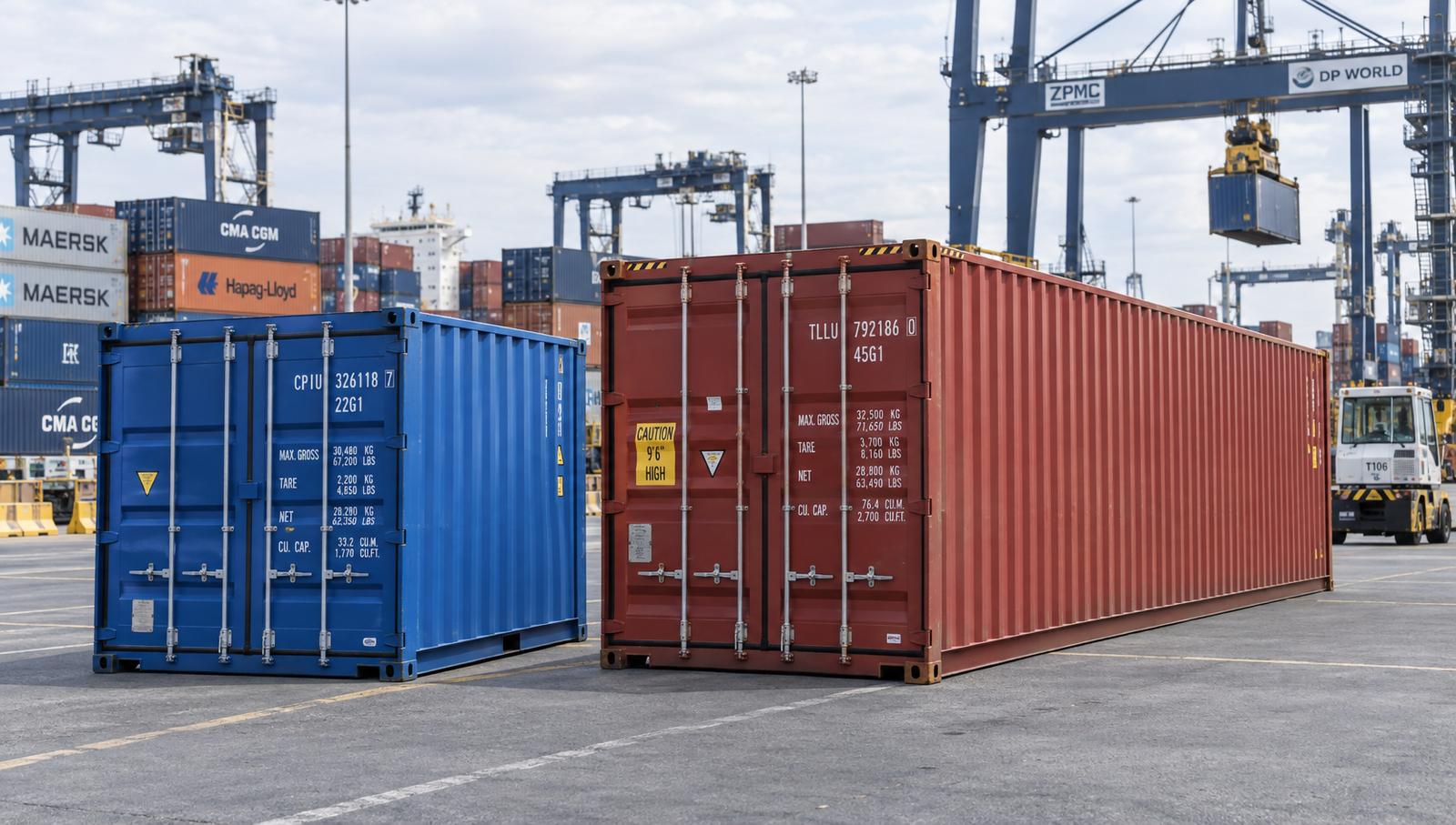
Check the equipment data plate or specification sheet for tare weight and maximum gross mass. Ask the freight forwarder to review the loaded weight, weight distribution, securing method, and applicable inland transport limits. A load that fits dimensionally may still be unsuitable because of its weight or the way that weight is concentrated.
Choosing the Right Container for the Cargo
The best container is the one that accommodates the packed shipment and its handling requirements without creating unnecessary transport constraints. Cargo density, physical shape, access needs, and total weight often matter as much as volume.
When a 20-foot container makes sense
A 20-foot container can suit dense cargo, compact machinery, or smaller consignments that do not use enough space to justify a longer unit. It may also help when a shipment’s weight reaches a practical transport limit before its available volume is full. Confirm the payload and road transport constraints instead of assuming a shorter container can automatically carry any heavy load.
When a 40-foot container makes sense
A 40-foot container provides substantially more floor length and nominal internal volume than a 20-foot unit. It can suit larger carton consignments, palletized products, and long cargo that fits within its internal dimensions and door opening. The extra space is useful only when the cargo can be arranged efficiently and the resulting gross weight remains acceptable.
When to consider a high-cube container
A high-cube container adds approximately one foot of external height compared with a standard-height container. It may suit tall cartons, bulky lightweight products, or cargo that needs more vertical clearance. The extra height does not increase the width or length, and it does not remove door-clearance restrictions.
Before selecting a high cube, compare the packed load height against both the door opening and internal clearance. Also verify that the required equipment is available for the planned route and that its dimensions work with the loading site and inland transportation arrangements.
Measurements to Confirm Before Booking
A freight forwarder can make a more reliable equipment recommendation when the shipper provides complete cargo measurements and handling details. A carton count or total cubic volume alone may not reveal an oversized piece, a door-clearance problem, or a concentrated weight load.
- Packed dimensions: Record the maximum length, width, and height of each crate, pallet, machine, or other shipping unit after packaging is complete. State the unit of measurement and identify any pieces that cannot be rotated.
- Quantity and configuration: Provide the number of pieces, total gross weight, individual piece weights where relevant, and pallet or carton arrangement. Note whether stacking is permitted and whether cargo has fragile, top-heavy, or irregular features.
- Loading method: Explain whether the site uses a forklift, crane, ramp, or another loading method. Confirm the door clearance, approach space, lifting points, and working room required for the largest item.
- Transport route: Identify the planned pickup and delivery locations, equipment requirements, and any route-specific height, width, gross-weight, or axle-load restrictions that need review.
- Equipment confirmation: Ask the forwarder to verify the available container’s internal dimensions, door opening, weight ratings, and suitability for the planned loading and securing method before the booking is finalized.
In a shipment with both ocean transport and inland delivery, the container choice must work across the full movement. For trucking, the loaded container’s gross weight, chassis combination, and applicable road restrictions can affect feasibility. Confirm the inland arrangements through the relevant trucking freight service planning process when road transport forms part of the shipment.
If the cargo exceeds standard container dimensions or cannot pass through the available doors, ask the forwarder to assess specialized equipment or alternative cargo handling. Depending on the cargo and route, break-bulk shipping options may be worth evaluating. Suitability depends on the cargo’s lifting and securing requirements, handling facilities, and the transport service available for the route.
Common Measurement Mistakes and Operator Checks
Two planning mistakes account for many avoidable container-fit problems: using the external dimensions as the loading space and relying on total volume without checking individual cargo geometry.
Common mistake: Measuring the unpackaged product. Packaging, pallet boards, protective frames, and protruding components increase the space a shipment occupies. Measure the finished shipping unit and update the figures if the packaging changes before dispatch.
Operators should also avoid treating cubic capacity as proof that cargo will fit. Several pieces may fit within the total volume mathematically but fail to fit through the door or arrange within the available floor space. Request a loading layout when the cargo is irregular, unusually large, or difficult to reposition.
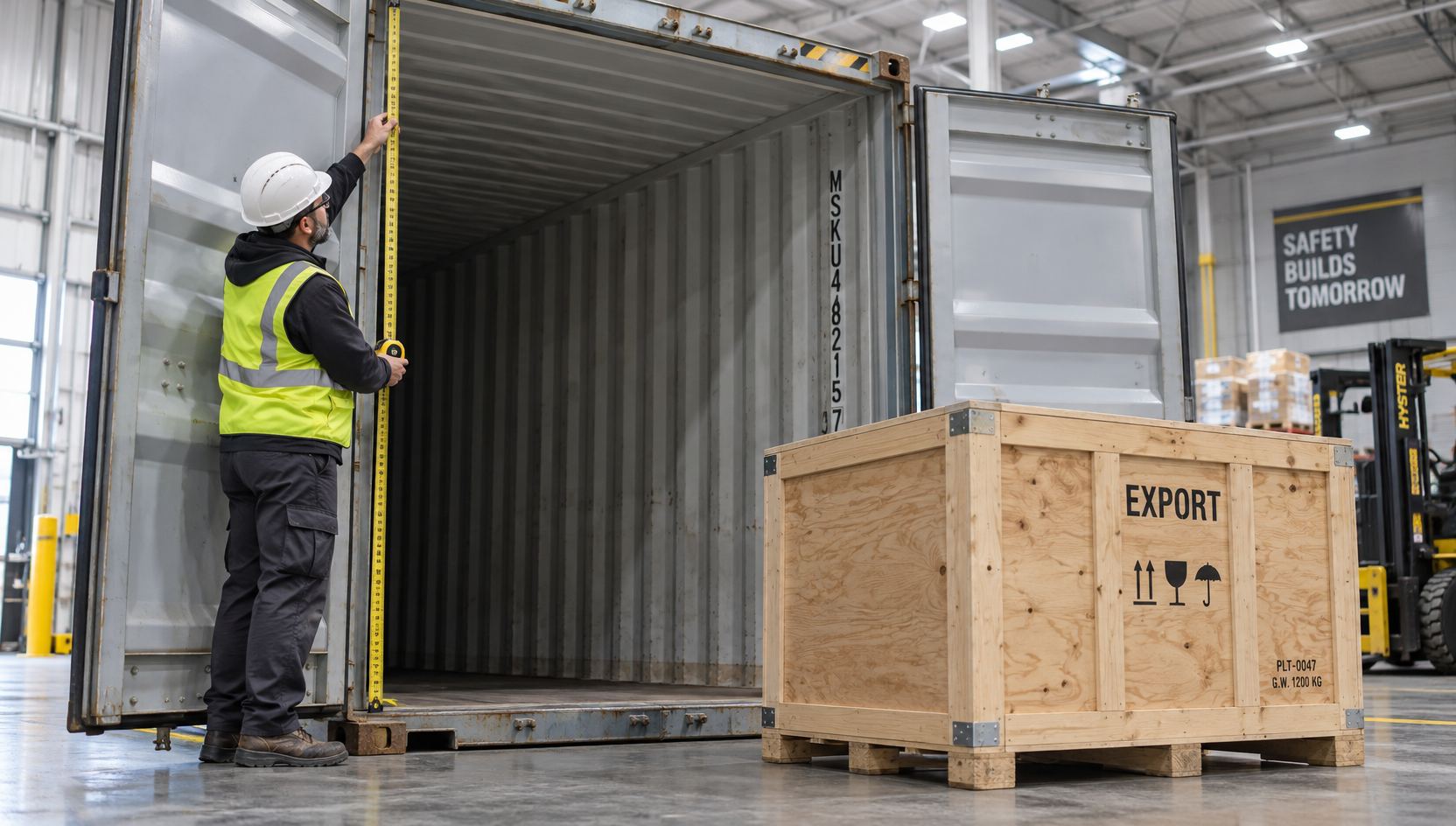
Operator check: Before loading, compare the actual packed dimensions and weights against the approved shipment data and the selected unit’s specifications. Escalate any discrepancy before the cargo enters the container, especially when the difference affects door clearance, weight distribution, or securing.
These checks are particularly important when suppliers provide measurements at different stages of production. The booking team, cargo packer, warehouse, and transport coordinator should work from the same final measurements and identify who must approve any change to the cargo configuration.
Disclosure: This guide provides general logistics information and may refer to services relevant to the topic. Carrier terms, customs requirements, fees, service coverage, and operating conditions can change. Confirm current requirements and responsibilities before acting.
Key Takeaways
- Use published container dimensions to shortlist equipment, not as a substitute for the actual unit’s specifications.
- Compare packed cargo dimensions with internal space and door openings before confirming the container type.
- Use nominal cubic capacity as a screening measure, then verify the loading arrangement for the individual pieces.
- Check payload, weight distribution, and route-specific transport limits separately from dimensional fit.
- Give the freight forwarder final measurements, gross weights, handling details, and route information before booking.
Shipping Container Dimensions: Frequently Asked Questions
What are the standard dimensions of a shipping container?
Common dry containers are 20 feet or 40 feet long, with an external width of about 8 feet. Standard-height units are approximately 8 feet 6 inches tall, while high-cube units are approximately 9 feet 6 inches tall. Internal dimensions vary by equipment, so confirm the specific unit before loading.
What is the difference between internal and external container dimensions?
External dimensions describe the container’s outside length, width, and height. Internal dimensions describe the space available inside its walls and roof. Internal measurements are the starting point for cargo fit, but door openings and loading clearance must also be checked.
How much cargo fits in a 20-foot container?
A common 20-foot dry container has a nominal internal volume of about 33.2 cubic meters. The practical load depends on packaging, piece dimensions, pallet arrangement, stacking restrictions, payload, and weight distribution. Total volume alone does not determine how much cargo will fit.
Is a 40-foot container always better for bulky cargo?
No. A 40-foot container provides more floor length and nominal volume, but the cargo still needs to clear the doors and fit within the interior. A 20-foot unit may suit a dense load, while a high cube may suit tall cargo. Weight and handling constraints can change the choice.
What is the difference between a standard container and a high cube?
A high-cube container is approximately one foot taller externally than a standard-height container of the same length. It offers additional internal height, which can help with suitable tall or bulky cargo. Confirm the precise internal height and door opening for the offered equipment.
Do shipping container dimensions include door clearance?
No. Published external and internal dimensions do not mean that the entire interior cross-section is available through the doors. The door opening is narrower and shorter than the interior in common dry containers. Compare the packed cargo dimensions with the actual door opening and loading orientation.
Can cargo fit inside a container but still be unsuitable for shipment?
Yes. Cargo may fit dimensionally but exceed the permitted gross weight, create an unsuitable weight distribution, lack adequate securing points, or conflict with inland transport restrictions. The forwarder and relevant transport operators need to assess the complete loaded configuration and route.
What information should I provide to confirm the right container?
Provide the packed length, width, and height of each shipping unit, the piece count, gross weights, total quantity, stacking restrictions, and loading method. Include the pickup and delivery locations and identify any items that cannot be rotated or require special handling. Ask the forwarder to confirm the exact equipment dimensions, payload, and route constraints.
Disclaimer: This article is general informational guidance, not a binding quotation, legal opinion, customs ruling, carrier commitment, or delivery guarantee. Requirements, charges, service terms, and responsibilities can vary by route, cargo, contract, carrier, and jurisdiction. Confirm current requirements before booking or filing.