

For most shippers, the answer to how many pallets fit in a 53 trailer is 26 standard 48×40 pallets, single-stacked, in a 53-foot dry van loaded straight with the 48-inch side running along the trailer. Turning the pallets so the 40-inch side runs along the trailer can raise the count to about 30, but only when the interior is wide enough and the pallets do not overhang.
Floor space is only one limit. A trailer filled with heavy pallets often reaches its payload limit before it runs out of floor positions, and a refrigerated trailer usually offers less usable space than a dry van. This guide explains the floor-plan arithmetic, compares straight and pinwheel loading, shows how to test weight against space, and lists the checks to run with the carrier before the load is tendered.
How Many Pallets Fit on a 53-Foot Trailer by Loading Pattern
Pallet capacity starts with floor-plan arithmetic. A 53-foot dry van typically offers roughly 630 inches of interior length and about 100 inches of interior width, although the exact figures vary by trailer builder, age, and wall lining. Dividing usable length by the pallet side that runs along the trailer gives the number of rows, and each row holds as many pallets as the width allows.
| Loading pattern | How pallets sit | Planning count | Condition to confirm |
|---|---|---|---|
| Straight | 48-inch side along the length, two across | 26 | About 624 inches of usable length |
| Turned | 40-inch side along the length, 48-inch side across | Up to 30 | At least 96 inches of width, no overhang |
| Pinwheel | Direction alternates from row to row | Often 26 to 30 | Pallet size, trailer width, unloading method |
| Double-stacked | Second tier on stackable pallets | Up to about twice the floor count by space | Stackable freight, height clearance, weight |
The straight pattern fits 13 rows of two pallets because 13 rows of 48 inches use 624 inches. The turned pattern fits 15 rows of two because 15 rows of 40 inches use 600 inches, but the two 48-inch sides take 96 inches across, which leaves only a few inches of clearance in a typical interior. Treat 26 as the baseline plan and 30 as an upside count that the carrier or loader must confirm against the actual trailer and pallets.
Straight vs Pinwheel Pallet Loading in a Dry Van
Straight loading points every pallet the same way, which keeps loading simple and keeps pallets reachable in delivery order. Pinwheel loading alternates pallet direction from row to row. It can interlock the load and use width that a straight pattern leaves open, but it takes more planning and may force the receiver to move some pallets to reach others.
Single-stop, uniform pallets: Turned or pinwheel loading can raise the count when pallets share one size, sit in good condition, and stay inside their footprint.
Multi-stop or mixed freight: Straight loading usually works better because each stop can reach its pallets without unloading the rest of the trailer.
Overhanging or uneven pallets: Straight loading leaves width to spare, while a 96-inch turned load tolerates very little overhang.
Ask the loader to sketch the planned pattern and mark which pallets belong to which stop before the trailer arrives. A sketch exposes blocked pallets and overhang problems while the freight is still on the dock.
Weight Limits Can Cap a 53 Foot Trailer Before Floor Space Does
Floor space and weight are separate limits, and the lower one governs. The gross vehicle weight limit commonly cited for the U.S. Interstate system is 80,000 pounds, and the tractor, trailer, fuel, and driver account for a large share of it. Payload therefore often lands in the low-to-mid 40,000-pound range, but the actual figure depends on the equipment, axle weights, and state rules.
To test a plan, divide the carrier-confirmed payload by the average loaded pallet weight and round down. Compare that result with the floor-space count and use the smaller number. Axle distribution adds a second check, because heavy pallets concentrated near the front or rear can exceed an axle limit even when total weight is acceptable.
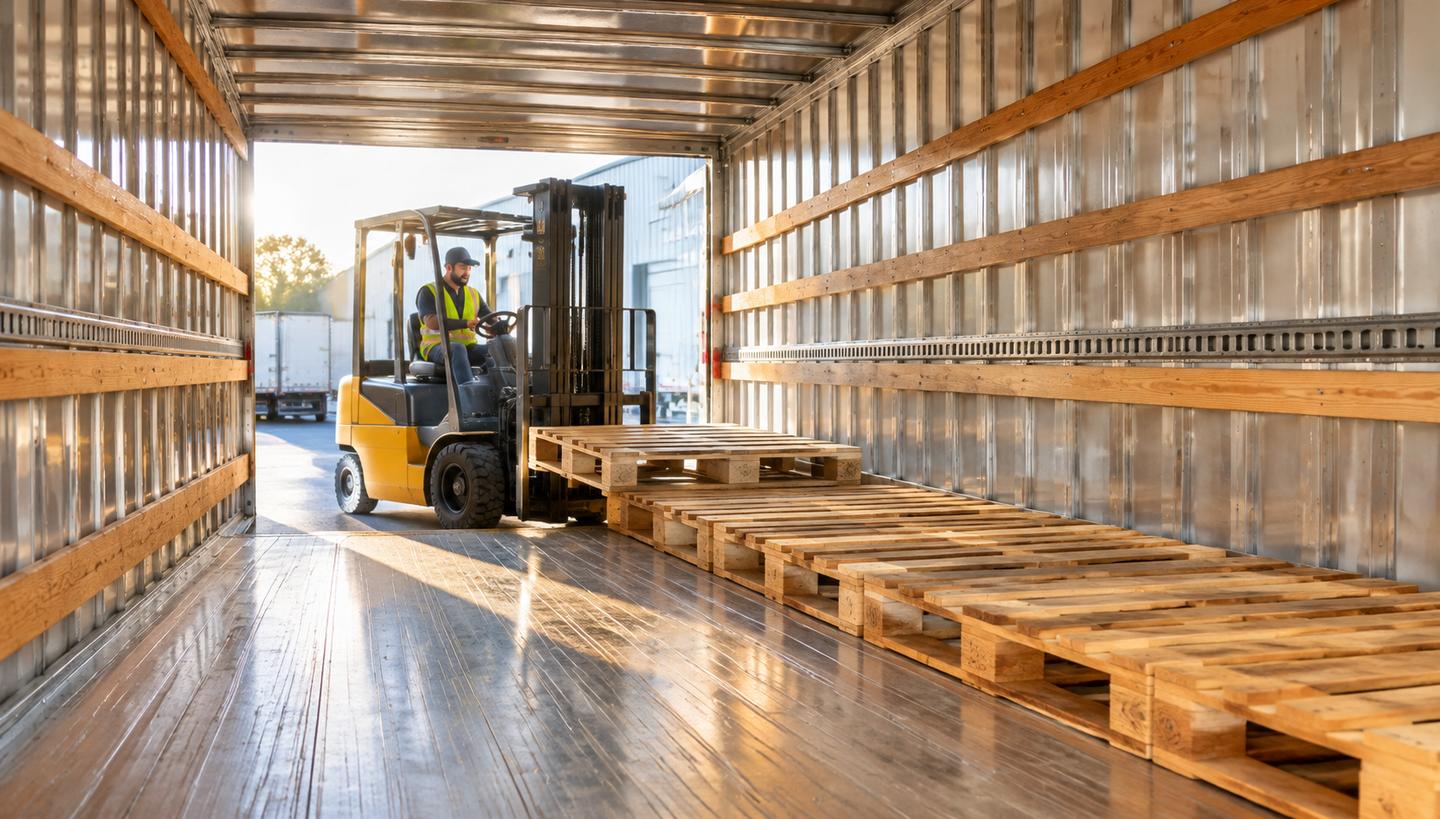
Hypothetical illustration: Assume a payload limit of 42,000 pounds and an average loaded pallet weight of 1,800 pounds. Dividing 42,000 by 1,800 gives about 23.3, so weight allows 23 pallets even though the floor holds 26. If the same freight were repacked to an average of 1,500 pounds per pallet, the result would be 28, and floor space would become the limit. Replace both numbers with the carrier’s payload and your actual pallet weights.
Shippers can settle both limits before pickup by confirming payload, axle limits, and the loading pattern through the carrier or a trucking freight provider.
Reefer Trailers, Semi Trailers, and What a 53 Truck Means
A refrigerated trailer usually holds fewer pallets than a dry van of the same length. Insulated walls reduce interior width and length, the refrigeration unit takes space at the front, and cold-chain loads often need air channels around the freight. A turned 96-inch load may not fit at all, so the practical reefer count is often at or a little below the straight dry van figure. Request the interior dimensions before assuming any number.
The same arithmetic applies to any semi trailer: add or remove rows according to interior length. Not every semi trailer is 53 feet, so confirm length first. In dock conversation, a “53 truck” normally means a 53-foot trailer, but the booking should still state whether the equipment is a dry van, a reefer, or another type.
When the Pallet Count Changes the Freight Plan
Palletized cargo that arrives in an ocean container rarely transfers one-to-one into a trailer. A 40-foot container is usually narrower than 96 inches inside, so a turned two-across pattern does not fit, and its length differs from a 53-foot trailer. Shippers planning an ocean freight shipment with inland trailer delivery should recount pallets for the trailer stage instead of reusing the container count.
Receiving sites may also add their own pallet height, weight, and labeling rules, which can reduce the count a trailer is allowed to carry. Anyone building pallets for Amazon FBA should check the destination’s current requirements before stacking and wrapping the load.
Common Loading Mistakes and Operator Checks
Two errors often cause count disputes: planning from the best-case number and ignoring weight until the truck arrives.
Quoting the 30-pallet count as the plan. When a shipper builds the load around 30 turned pallets and the trailer interior or pallet overhang does not allow it, the driver or dock may refuse the extra pallets or split the shipment. Plan on 26 instead, and treat the turned count as an upside that the carrier confirms before pickup.
An overweight or poorly distributed load can lead to fines, delays, or a forced reload, and the responsible party depends on the contract and jurisdiction. Confirm payload and axle limits before loading, not at the scale.
Packing and securement also affect claims. Review the terms of any cargo insurance policy for packaging and securement conditions, because coverage and responsibility for load shift or crushed pallets can depend on how the freight was built and loaded.

Disclosure: This guide provides general logistics information and may refer to services relevant to the topic. Carrier terms, customs requirements, fees, service coverage, and operating conditions can change. Confirm current requirements and responsibilities before acting.
Key Takeaways
- Plan on 26 single-stacked 48×40 pallets for a straight load in a 53-foot dry van, and treat up to 30 as a turned-load upside that needs confirmation.
- Compare the weight-based count with the floor-space count, and plan to the lower figure.
- Use straight loading for multi-stop, mixed, or overhanging freight, and consider turned or pinwheel loading for uniform single-stop freight.
- Request the interior specification for reefers and any non-53-foot equipment instead of reusing dry van numbers.
- Recount pallets whenever the freight changes container, trailer, or receiving site.
53 Foot Trailer Pallet Capacity FAQ
How many standard pallets fit on a 53 foot trailer?
Most planners use 26 single-stacked 48×40 pallets in a dry van, with the 48-inch side along the trailer. A turned load may reach about 30 when the interior is wide enough and the pallets do not overhang. The carrier confirms the final figure for the specific trailer.
How many pallets can fit on a 53 foot trailer when the freight is heavy?
Weight may cut the count below the floor-space figure. Divide the carrier-confirmed payload by the average loaded pallet weight, round down, and use the lower of that number and the floor-space count.
How many pallets fit in a 53 foot reefer trailer?
The count is often at or slightly below the straight dry van figure because insulation, the refrigeration unit, and airflow clearance reduce usable space. A turned 96-inch pattern may not fit. Ask the carrier for the reefer’s interior dimensions before planning.
How many pallets fit in a semi trailer?
The count follows interior length, so confirm the trailer’s length and type first. In straight loading, each additional 48-inch row adds two standard pallets. When someone says “53 truck,” they usually mean a 53-foot trailer, but the equipment type should still be confirmed.
Is straight or pinwheel loading better in a dry van?
It depends on the freight. Straight loading suits multi-stop routes and imperfect pallets, while pinwheel or turned loading may add pallets for uniform, single-stop loads. Check whether the receiver can unload the pattern before choosing it.
Can pallets be double-stacked in a 53 trailer?
Double stacking can raise the count only when the freight is stackable, the stacked height clears the interior, and the combined weight stays within payload and axle limits. Many loads fail one of those tests, and weight usually binds first.
What should I send the carrier to confirm the pallet count?
Provide pallet dimensions, loaded height, weight per pallet, stackability, the number of stops, and the equipment type. These inputs let the carrier or loader test both floor space and weight.
Do pallet sizes other than 48×40 change the count?
Yes. Divide the trailer’s interior length by the pallet side that runs along it and the interior width by the side that runs across, rounding each result down. Then multiply the two numbers and confirm the result against the actual trailer.
Disclaimer: This article is general informational guidance, not a binding quotation, legal opinion, customs ruling, carrier commitment, or delivery guarantee. Requirements, charges, service terms, and responsibilities can vary by route, cargo, contract, carrier, and jurisdiction. Confirm current requirements before booking or filing.