

Reviewed by TJ Logistics Team October 2026. TJ Logistics Team reviewed the route content, current planning references, and Colombia destination-preparation points for this review month. The formal quotation and booking are prepared against the defined shipment.
Shipping from China to Colombia: Route Overview
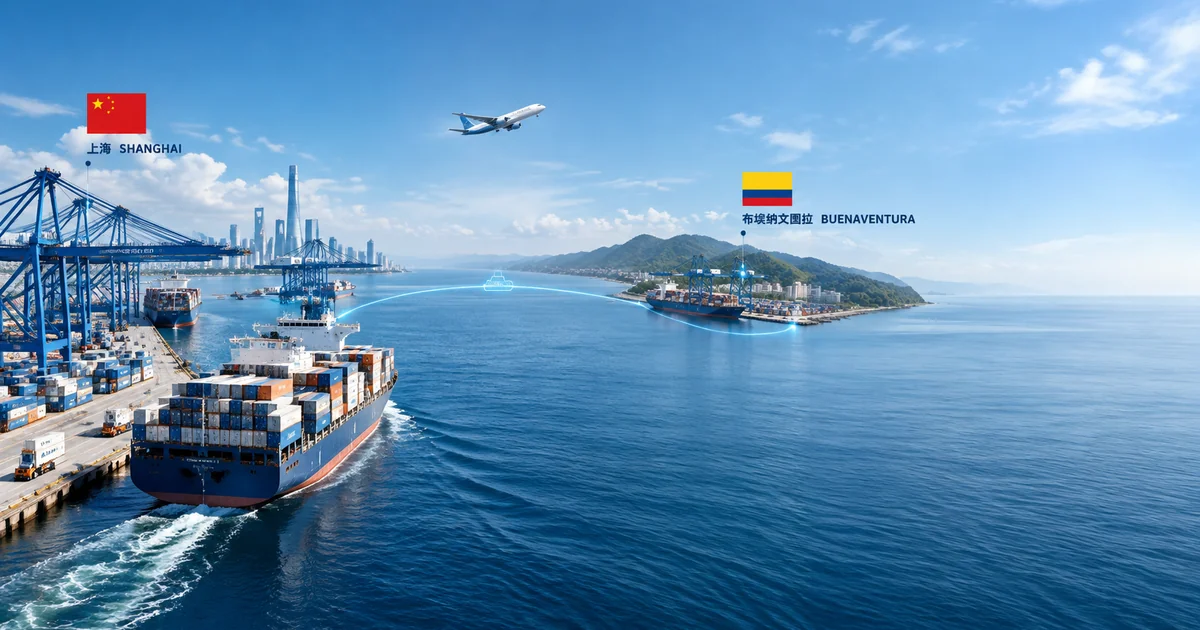
Shanghai, China → Buenaventura, Colombia FCL 20GP is a practical starting comparison for container-ready cargo. The appropriate container size depends on the loading plan, cargo dimensions, and the consignee’s receiving conditions.
The complete China-to-Colombia movement connects supplier readiness and the China export handoff to the selected ocean or air route, Colombian entry and customs clearance, and final delivery. The main decision is whether dedicated-container, shared-container, air, or express movement fits the shipment and its delivery deadline.
China to Colombia Shipping Cost and Transit Time
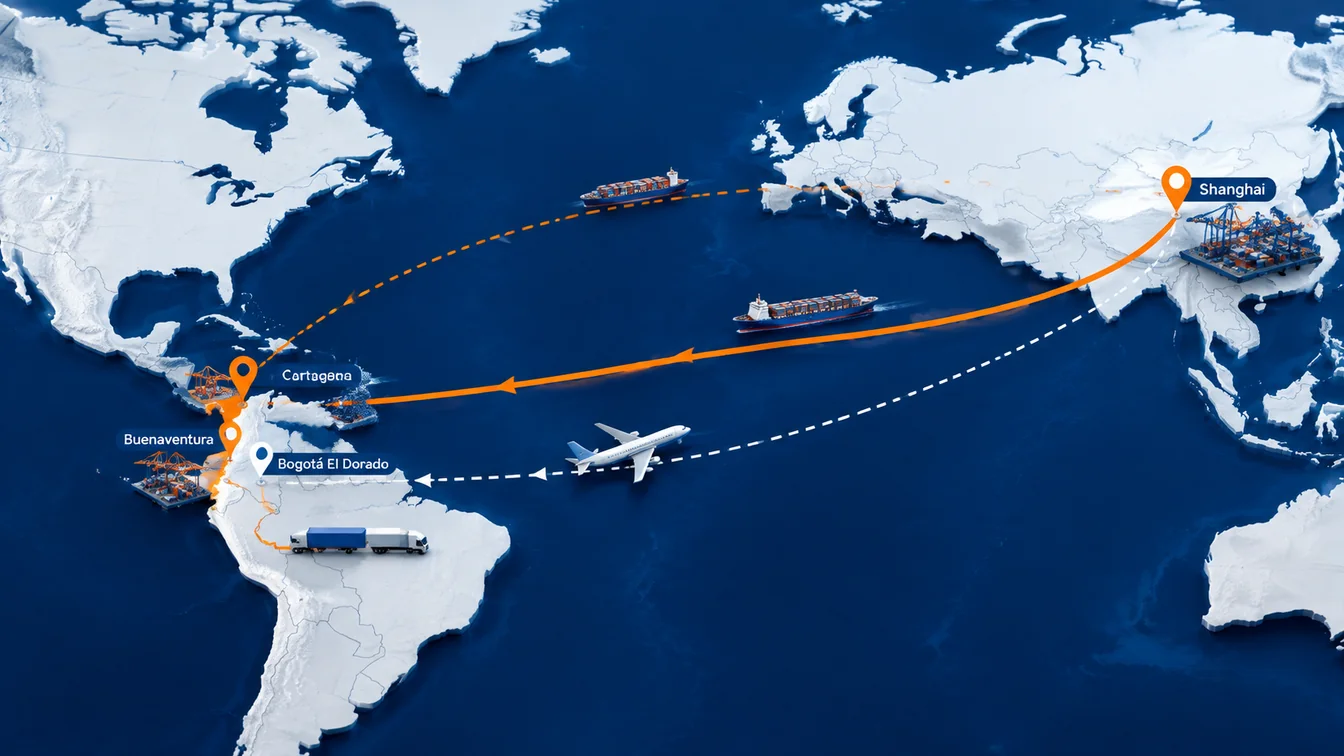
Current TJ Logistics Team planning references provide route-specific China-to-Colombia prices and transit times for October 2026. Each reference applies to its named route, method, equipment, or charging unit.
| Shipping route | Shipping method | Price | Transit time |
|---|---|---|---|
| Shanghai, China → Buenaventura, Colombia | FCL 20GP | $2,160–$3,600 per container | 30–40 days |
| Shanghai, China → Buenaventura, Colombia | FCL 40GP | $2,520–$4,320 per container | 30–40 days |
| Shanghai, China → Buenaventura, Colombia | FCL 40HQ | $2,700–$4,500 per container | 30–40 days |
| Major Chinese ports → Buenaventura / Cartagena, Colombia | LCL | $63–$112.5/CBM | 42–58 days |
| China (origin airport unspecified) → Bogotá El Dorado (BOG), Colombia | Air freight | $7.65/kg | 2–4 days |
| Major Chinese cities → Colombia (destination city unspecified) | Express | $12.11/kg | 2–5 days |
Rate scope: These TJ Logistics Team planning references apply to the shipping route, method, equipment or unit shown. They are not market averages or binding quotations. The formal quotation confirms the agreed collection, delivery, customs, and charge scope for the shipment.
How to Choose a Shipping Method from China to Colombia
The right method for shipping from China to Colombia follows the cargo’s physical form, required arrival date, and final delivery scope.
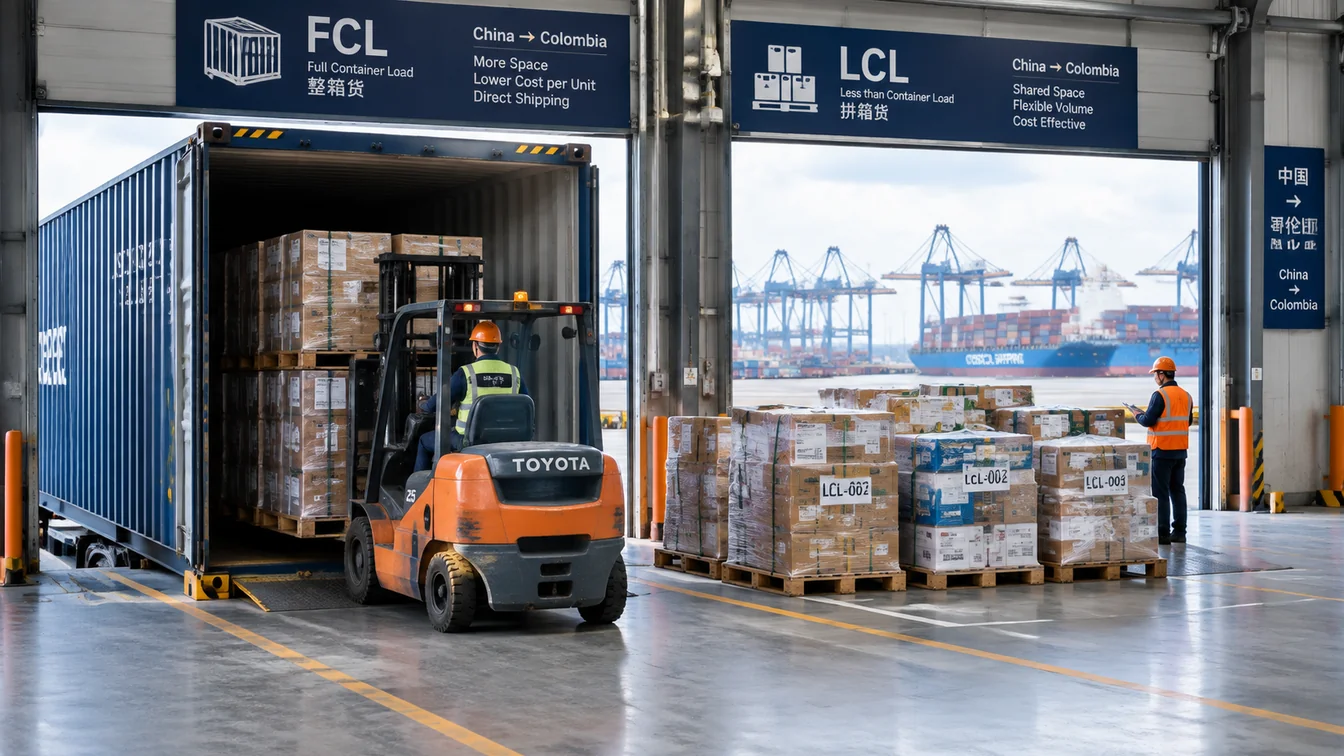
- Choose FCL when cargo requires dedicated container capacity or controlled container loading, because containerized movement provides a defined equipment and loading plan; the selected size must match the actual cargo and receiving arrangements.
- Choose LCL when cargo can share container capacity with other shipments, because shared-load transport avoids requiring a dedicated container; origin consolidation and destination handling affect the practical fit.
- Choose air freight when the delivery deadline justifies airport-based cargo handling, because the route can reduce the international transport time compared with the stated ocean planning references; cargo acceptance and chargeable weight remain important constraints.
- Choose express when a time-sensitive consignment fits a courier’s accepted parcel and delivery scope, because network-based handling can suit urgent smaller shipments; service eligibility and the delivery address can change the available option.
- FCL container shipping
- Use when: the shipment needs dedicated container space, and the loading plan supports the selected equipment. Key route check: compare the 20GP, 40GP, and 40HQ equipment requirements against cargo dimensions, loading responsibility, and destination receiving arrangements. The sea freight service provides the relevant service-navigation starting point.
- LCL shared-container shipping
- Use when: cargo can be consolidated with other shipments rather than occupying a dedicated container. Key route check: establish the actual origin handoff and consolidation arrangement, then account for the destination release and onward-delivery requirements.
- Air freight
- Use when: the delivery deadline justifies air transport and the goods meet the applicable cargo acceptance requirements. Key route check: the stated China origin airport is unspecified, so the actual origin airport, cargo dimensions, chargeable weight, and final delivery arrangements determine the usable movement.
- Express shipping
- Use when: a time-sensitive shipment fits the intended courier service and destination coverage. Key route check: package dimensions, declared contents, applicable customs requirements, and delivery-address eligibility must fit the selected service; the express service page provides the relevant service-navigation option.
Plan the China-to-Colombia Route from Supplier to Final Delivery
After the method is selected, the common movement starts with supplier-ready cargo and the agreed China-side handoff, continues through export handling and international transport, and proceeds through Colombian arrival, customs release, and delivery to the consignee’s final address. The operational differences are the handoffs needed to move each shipment type through that chain.
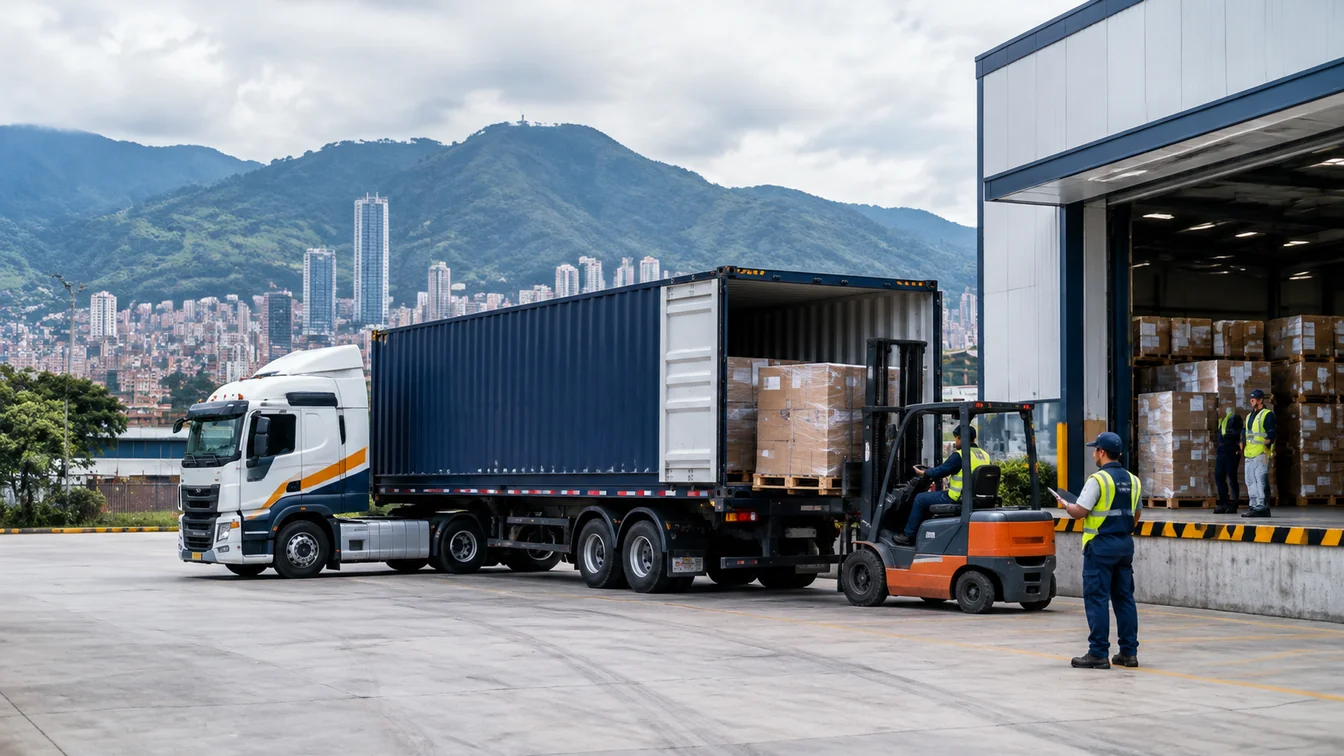
- FCL: container loading and release
- Define who loads the container, who delivers it into the agreed export movement, and who arranges destination release and onward collection. The execution plan must assign responsibility for container return and any required receiving appointment rather than treating these as automatic parts of ocean transport.
- LCL: consolidation and destination handling
- Arrange the origin cargo handoff and consolidation timing, then establish the agreed destination release and deconsolidation arrangements. Inland delivery should follow the actual service boundary rather than being assumed to form part of the international LCL movement.
- Air freight: airport cargo handoffs
- The air freight service is relevant to this shipment method. Cargo acceptance, terminal handling, arrival release, and subsequent collection or delivery must be coordinated around the actual airports and accepted cargo; the current route reference does not specify the China origin airport.
- Express: parcel-network handoffs
- Express transport uses the selected service’s pickup and parcel-network handoffs rather than a dedicated-container movement. The declared contents and shipment details must support service acceptance, and the final delivery arrangement must match the service’s coverage and customs process.
Execution Checks Before Booking
- For FCL, allocate responsibility for container loading, destination collection, empty-equipment return, and any receiving appointment.
- For LCL, establish the origin cargo handoff and consolidation cutoff, along with the agreed destination release and deconsolidation boundary.
- For air and express, align cargo readiness with the actual acceptance cutoff and establish who takes responsibility at the destination handoff.
Choosing Colombia’s Entry Gateways and Inland Delivery Routes
Colombia’s entry choice changes the inland plan because the ocean references cover Pacific-side and Caribbean-side coastal gateways, while the air reference identifies Bogotá as the arrival city. The consignee’s delivery municipality and the required final service determine which entry and inland combination is practical.
| Final delivery area | Typical route pattern | Why the pattern fits | Details needed for the quote |
|---|---|---|---|
| Western Colombia and Pacific-side destinations | Shanghai → Buenaventura is the named FCL pattern; the LCL scope also includes this Pacific-side entry. | This coastal entry is a candidate when the western delivery area and onward road movement fit the shipment’s destination. The final overland leg remains a separate part of the route decision. | The final municipality and receiving access determine the onward trucking freight requirements. |
| Caribbean-side and northern coastal destinations | The LCL reference also names Cartagena as an entry option; the FCL references are tied to the Shanghai-origin route to the Pacific-side gateway. | A Caribbean-side entry provides a different geographic comparison when the final delivery area and onward inland movement make that coast suitable. The LCL reference does not establish an FCL price for this alternative. | The delivery municipality and the required inland movement determine whether the coastal entry fits the final destination. |
| Bogotá-oriented and time-sensitive cargo | The air-freight reference names China (origin airport unspecified) → Bogotá El Dorado (BOG); ocean arrival requires a separate inland movement from a seaport. | The airport’s published information describes cargo-terminal facilities, making the named airport relevant to air cargo planning. The final consignee address determines the subsequent collection or delivery arrangement. | The required arrival date and final delivery address determine whether air transport fits the complete movement better than an ocean route with inland delivery. |
Prepare a Comparable Freight Request
Provide: the China supplier or pickup point; cargo-ready timing and cargo profile, including type, packages, dimensions, weight, and CBM; any loading or special-handling condition; the final postal code and receiving conditions; and the requested delivery scope, timing priority, and relevant importer or broker arrangement.
The formal quotation should state: the pickup and final-delivery boundary; transport method, equipment or unit, and routing pattern; customs, destination-handling, and inland-delivery handoffs; material included and excluded charges; rate validity; and the conditions that can change the amount or timing.
Prepare for Colombian Customs Before Departure
The Colombian importer or its authorized declarant is responsible for a complete import declaration and the supporting documents required for the goods. Commercial and transport records are central to the declaration, while import licenses, origin evidence, health documents, or other approvals are required when the applicable product rules call for them; DIAN’s import-declaration guidance identifies supporting records and the conditions governing mandatory advance filing.
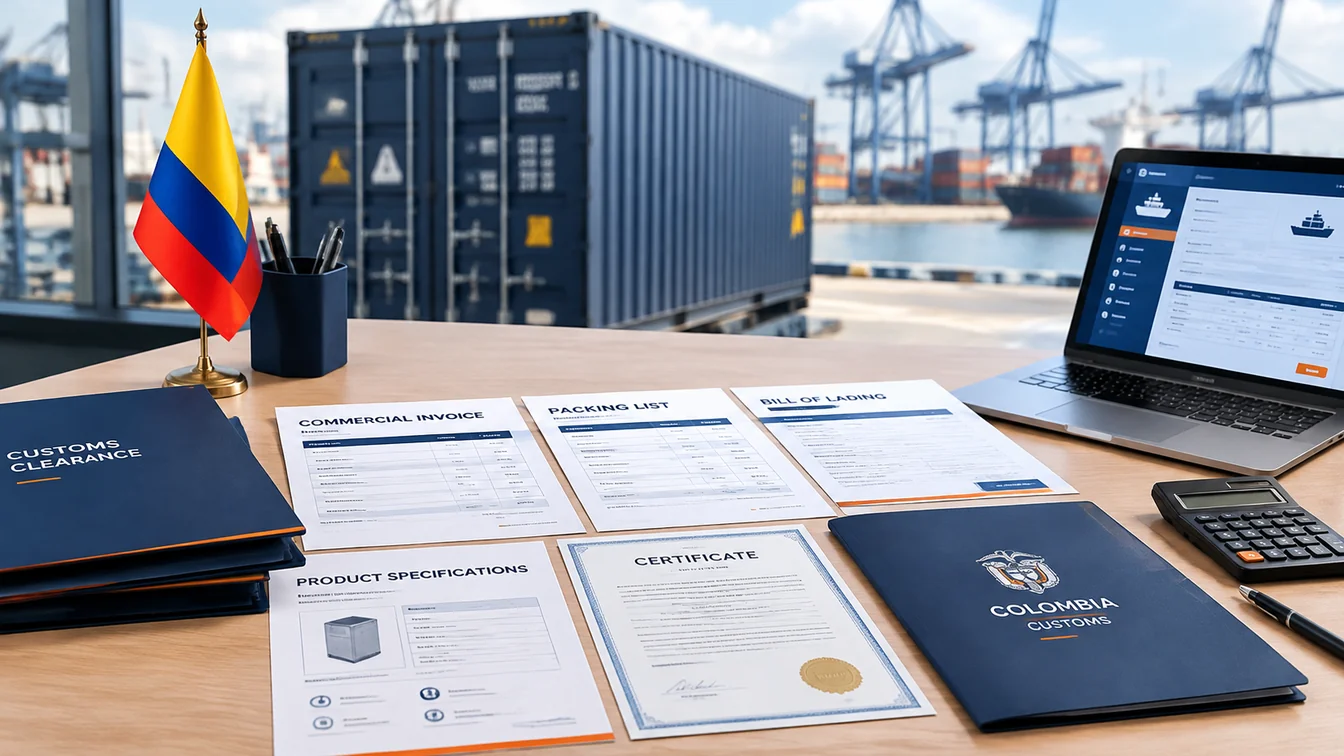
A customs agency can support the declaration process where appropriate, but appointing a representative does not remove the importer’s responsibility for accurate product, value, and approval information. The customs brokerage service is a relevant coordination option for defining that working relationship.
What You May Pay at Import
Colombian import outlay may include customs duty and import VAT (IVA), calculated under the applicable customs-value and tariff rules. Product classification, customs valuation, and any specific tax treatment determine the actual amount; DIAN’s customs-procedure guidance explains the calculation components without establishing a universal rate for China-origin goods.
Customs Readiness Checklist
The Colombian importer should settle product classification, declaration responsibility, and applicable approvals before dispatch, because these determine the preparation required for customs entry.
- Assign the Colombian importer and the party responsible for submitting the import declaration; prepare an appropriate mandate if a customs agency is appointed and the arrangement requires one.
- Determine the applicable Colombian tariff subheading from the product’s function, composition, and technical description before estimating import charges or screening restrictions.
- Reconcile the commercial transaction details and customs-value supporting information so that the declared goods and relevant valuation elements are consistent.
- Record the actual country of origin and prepare origin evidence when a preferential claim or another applicable rule requires it.
- Screen the goods for import registration, licensing, sanitary approvals, technical requirements, and other prior authorizations that may apply to the commodity.
- Determine whether the goods or tariff subheading falls within mandatory advance-declaration rules; the applicable deadline depends on the relevant customs requirements and shipment circumstances.
- Allocate responsibility for paying applicable duties and IVA and responding to documentary or physical inspections, recognizing that advance filing does not guarantee release.
Documents to Prepare
- Commercial invoice with accurate product descriptions, quantities, transaction values, currency, and origin information.
- Packing list when required or appropriate, consistent with the actual packages and cargo details.
- Transport document, such as the bill of lading or air waybill applicable to the selected method.
- Supporting information for customs classification and valuation, together with any other transaction records required for the declaration.
- Origin evidence or a certificate of origin when relevant to the applicable trade treatment or other customs requirement.
- Import registration, license, sanitary certificate, or other prior authorization when required for the specific goods.
- Customs agency mandate and the supporting documents for an Andean Value Declaration when those documents are applicable.
Mandatory advance-declaration rules and product controls can vary by tariff subheading and operation. Incomplete preparation can affect customs release, and advance filing does not eliminate the possibility of inspection.
Choose the Right Delivery Scope for China-to-Colombia Shipping
The service scope determines which transport legs and operational handoffs are included in the agreed movement. The endpoint names alone do not assign all collection, customs, or final-delivery responsibilities to one party.
| Service scope | What the scope means | Key responsibility or condition |
|---|---|---|
| Port-to-port | Ocean transport between the agreed origin and destination ports. It does not by itself include supplier collection, import customs clearance, or final inland delivery. | The buyer or appointed parties arrange the legs before and after the agreed port movement. Any additional transport or handling must be allocated separately. |
| Airport-to-airport | Air transport between the agreed cargo airports rather than between the supplier’s and consignee’s addresses. Supplier collection and final-address delivery are separate legs unless included in the agreed service. | The parties must allocate origin cargo delivery, airport acceptance, customs clearance, and destination collection or onward delivery. The actual quotation determines which of those handoffs are included. |
| Door-to-door | Coordinated movement from the named China pickup address to the named Colombia delivery address. The scope may combine international transport, destination handling, and inland delivery. | Import customs and duties remain the importer’s responsibility unless the agreed terms expressly allocate specific obligations differently. Final-address access and receiving arrangements can affect delivery execution. |
A door-to-door service arrangement can coordinate pickup and final-address delivery without automatically transferring Colombia’s import obligations away from the importer. Cargo insurance is a separate coverage decision and should not be treated as automatically included in a freight service.
Why Use a Freight Forwarder for Shipping from China to Colombia?
A freight forwarder helps turn shipment information into a usable movement definition, match transport and gateway choices to the final delivery requirement, and align the commercial and operational handoffs. On the China-to-Colombia route, these decisions connect the supplier’s cargo readiness with the chosen entry and the consignee’s inland delivery needs.

Comparable movement definitions: Freight quotations can describe different pickup points, transport legs, or endpoints even when their service labels appear similar. A forwarder helps define the movement being compared so that the proposed scope reflects the intended shipment.
Gateway and delivery fit: A suitable international movement may still produce an impractical inland leg. A forwarder helps relate the supplier’s origin, the chosen transport method, the Colombian entry area, and the actual delivery destination without treating one gateway as universally preferable.
Clear responsibility handoffs: A shipment can be ready for transport while import documentation or the destination receiving arrangement remains unresolved. A forwarder helps clarify which party supplies information, which party handles each handoff, and who must make the next operational decision without replacing the importer’s statutory responsibilities.
How TJ Logistics Team Plans a China-to-Colombia Shipment
- Shipment-definition review
- TJ Logistics Team reviews the defined shipment request and flags route-specific information gaps that would prevent a meaningful method or service-scope decision.
- Gateway and method mapping
- TJ Logistics Team maps the relevant FCL, LCL, air-freight, and express scopes against supplier location, cargo requirements, timing priority, and the Colombian final delivery area without assuming an unverified direct connection.
- Service-boundary and responsibility record
- Before a formal quotation is prepared, TJ Logistics Team records the agreed collection, international movement, destination handoff, final-delivery boundary, and parties responsible for the next operational steps.
- Booking and change coordination
- After the buyer accepts the agreed quotation and scope, TJ Logistics Team coordinates booking information, commercial-document handoffs, and cargo handover. If readiness, routing, documents, or delivery conditions change, the team flags the affected handoff and the party responsible for the next action.
China to Colombia Shipping FAQ
How much does it cost to ship a 20ft container from China to Colombia?
For Shanghai, China → Buenaventura, Colombia FCL 20GP, TJ Logistics Team’s October 2026 indicative client rate reference is $2,160–$3,600 per container. This container-specific reference is a starting comparison for cargo that suits dedicated equipment; other container sizes have their own separate planning references.
How long does sea freight from China to Colombia take?
For Shanghai, China → Buenaventura, Colombia FCL 20GP, TJ Logistics Team’s October 2026 planning-transit reference is 30–40 days. Use this timing for the named FCL reference rather than assuming it applies to shared-container cargo or a different entry and delivery arrangement.
What is the cheapest way to ship from China to Colombia?
FCL is a practical starting comparison for container-ready cargo, LCL for cargo that can share container capacity, and air or express for time-sensitive consignments. There is no supported universal cheapest method because the planning references use different charging units, equipment, routes, and service scopes.
Which China port should I use for shipping to Colombia?
The starting point is a China export gateway that fits the supplier’s location and the required ocean movement; the current FCL comparison is tied to a Shanghai-origin route, while the LCL scope includes coastal entry choices on different sides of Colombia. The final delivery municipality and inland movement determine whether the selected gateway remains practical.
What documents should I prepare for importing goods into Colombia?
A normal Colombia import file starts with the commercial invoice and transport document, with a packing list where appropriate. Depending on the commodity and import procedure, the importer may also need valuation support, origin evidence, import registration or licensing, sanitary documents, prior approvals, and customs-agency authority.
Can I ship door-to-door from China to Colombia?
Yes, China-to-Colombia shipments can be planned around a door-to-door scope when the required collection and delivery arrangements are available. The agreement must distinguish transport coordination from the Colombian importer’s customs, tax, and product-compliance responsibilities.
Does every shipment entering Colombia require an advance customs declaration?
No, mandatory advance import declarations apply to the goods and tariff subheadings covered by the applicable rules rather than automatically to every Colombia-bound shipment. The importer or responsible declarant should establish the requirement before dispatch because the applicable filing deadline can affect the movement plan.
How should I choose between air freight and express shipping to Colombia?
Choose air freight when the cargo and delivery requirement suit airport-based transport, and choose express when the shipment fits the intended parcel service and its delivery scope. The China-to-Colombia planning references use different service and charging bases, so the choice should reflect the actual cargo, urgency, and final delivery arrangement rather than the per-kilogram figures alone.